Acknowledgement: Much of the information in this chapter is from
A Family History of the Freeman, Franklin, Lawrence and Lutton Families by Elizabeth Lahiff (1994)
***********
The Lawrences were a yeoman farming family from Thatcham, a market town in Berkshire. It is 3 miles east of Newbury, 14 miles west of Reading. "Thatcham has a claim in the Guinness Book of Records for being the oldest continuously inhabited place in Britain. The well-preserved remains of a Mesolithic settlement dating from 8400 to 7700 BC have been found in its vicinity. Evidence also exists of Bronze and Iron Age settlements and of a Roman settlement." (Wikipedia)
The Lawrences had resided in Thatcham for many generations. The family that emigrated to Australia consisted of
Luke - 3 x great grandfather, and his wife,
Eliza (nee Franklin) - 3 x great grandmother, and
Eliza’s brother William, his wife Sophia and their
respective children. Later, in 1855, having been widowed Eliza’s mother,
Elizabeth nee Freeman (4 x great grandmother) and four more of Eliza’s siblings also emigrated.
 |
| Thatcham in the early 20th Century |
The Lawrences of Thatcham
The earliest Lawrence ancestor traced with any certainty is
Edward Lawrence - 12th great grandfather who was born in 1511 at Thatcham, and died there on 28 October 1566. It appears that his father was
William Lawrence - 13th great grandfather - born in 1475 at Ashton Hall, Lancashire, died 10 June 1559 in Gloucestershire, and wife
Margaret née Kaye - 13th great grandmother - born about 1475. However, that could be a rubbery supposition.
Edward, and his unknown partner had:
Thomas - born about 1537 in Thatcham, died April 1608, Thatcham.
Richard Lawrence (11th great grandfather) - born 1541, Thatcham; died 19 Feb 1568, Thatcham, married
Joan née Smith (11th great grandmother) - born about 1567, Thatcham.
Stephen, born 1543, Thatcham; died 1607, Thatcham.
William - born 1545, Thatcham, died 23 October 1596, Thatcham.
Richard and Joan had
Vincent Lawrence (10th great grandfather) born about 1657 at Henwick (Thatcham). He married
Annis (or Annie) née Bradley (10th great grandmother), born about 1877, Thatcham.
Vincent and Annis had
Bradley Lawrence (9th great grandfather), born about 1611 at Henwick (Thatcham), died 12 March 1672 at Henwick (Thatcham). He married a woman named
Alice (9th great grandmother).
Bradley and Alice had
Bradley Lawrence (8th great grandfather), born 20 March 1641 at Thatcham. He partnered with
Elizabeth (8th great grandmother), born about 1633.
This Bradley also fathered a
Bradley Lawrence (7th great grandfather), born [date unknown] at Thatcham with wife
Elizabeth née Lake (7th great grandmother), born 1673 at Chipping Norton. Her father was
Thomas Lake (8th great grandfather), died about 1689 at Chipping Norton and
Philippa née Harris (8th great grandmother).
Bradley and Elizabeth had a son
John Lawrence (6th great grandfather), born April 1701 in Thatcham, died February 1777, Thatcham. John marred first
Alice née Platt (6th great grandmother), born 1706 in Reading. He had a second wife, Elizabeth Carter, born August 1702 in Brimpton.
John and Alice had:
- John Lawrence (5th great grandfather), born 11 August 1729, Thatcham, died 13 August 1796, Thatcham. Married Elizabeth née Edmonds (5th great grandmother), born 1738, Thatcham, died 30 Dec 1813 at Lodge Farm, Thatcham.
- Mary, born 1731, Thatcham, died 9 September 1766, Thatcham
- James, born 1734, Thatcham
- Thomas, born 1738, Thatcham
- Charles, born 1741, Thatcham.
John and Elizabeth had:
- Jane, born 1758, Thatcham
- Mary, born 21 January 1759, Thatcham, died 7 December 1792, Berkshire
- James, born 1760, Thatcham, died 13 August 1818, Thatcham
- Rebekah, born 1763, Thatcham
- Thomas Lawrence - (4th great grandfather), born 1765, Thatcham, died 23 August 1831 at Lodge Farm, Thatcham, married Susanna née Franklin (4th great grandmother). She was born in 1787, died 16 September 1847 at Thatcham. Her brother Benjamin Franklin was another 4th great grandfather, born in 1792 died in 1847 and married Elizabeth née Freeman - 4th great grandmother, born in1796, emigrated to Australia and died in 1874. They were the parents of Luke’s wife Eliza Thus Luke and his wife, Eliza, were first cousins.
- Noah, born 29 May 1869, Thatcham, died 22 September 1824, Thatcham
Thomas and Susanna’s fourth child of five, son
Luke Lawrence - 3rd great grandfather - was born in 1818 at Lodge Farm, Thatcham, and died on 1 August 1885 at Parramatta, not in very good circumstances, as we shall see.
 |
| Lodge Farm, Thatcham |
Thomas had been a squire (country landowner / gentleman) of the village of Thatcham.
According to Luke’s daughter, Elizabeth (known as Lizzie) Susannah Lawrence, Luke and his brothers were educated at Eton. Luke went up to Oxford planning to be an architect. He did not complete his studies, possibly because of the father’s death and so worked as a carpenter.
Marriage of Luke and Eliza (Lizzie)
Luke Lawrence and Eliza Franklin were married in Newbury in March 1848.
After their marriage Luke and Eliza travelled to America, to meet Luke’s brother, James Lawrence, who had settled there. He never married, and died in America. Luke and Eliza's first child was born in America, but did not live, and Eliza refused to remain there. According to Lizzie, their daughter, her parents dined with the President, and they travelled through Chicago. They returned to England, living at Marsh, Newbury, where Elizabeth had been born.
Social conditions in England and decision to move to Australia
England was going through troublesome times. The roads around Newbury and Reading were rife with highwaymen. Machinery which was being installed at Reading was smashed by the local people - Luddites. They feared for their livelihood during the Industrial Revolution sweeping Britain.
Lizzie’s uncle had encounters with highwaymen. On one occasion a “lady” dressed in a long cloak, requested her uncle to let her ride with him. He stopped the cart and was about to help “her” up, when he noticed a man’s high boots, so he pushed the highwayman back, whipped up the horse and drove with such speed into Reading that the horse dropped dead on reaching the town. On another occasion, when the hay in the cart was moved, a young woman with a pitch plaster over her face was found dead. Pitch plasters were used by highwaymen to suffocate people.
'Stand and deliver: The history of the highwayman', The Guardian/London Review of Books, 3 May 2002.
After these incidents Luke and Eliza Lawrence and Eliza's brother William and his wife Sophia, together with their children, decided to emigrate to Australia. One story is that they came to Australia to seek gold, and indeed Luke did go in search of gold at one time.
Prior to leaving Berkshire for Australia, Luke was given a large sword, or bayonet, and a smaller one like a large dagger made by a relative, Thomas Long, who had a foundry at Windsor. The swords were to be used to fight the “blacks” ie the Aborigines they thought they might encounter in their new country. The sword and dagger are still in the possession of the family. It appears that Luke’s father, Thomas, and uncle, James Lawrence, were officers in the Berkshire Yeomanry Cavalry, a volunteer army unit.
Emigration
The families sailed from Southampton aboard the
Harriet and arrived in Sydney on 11 June 1853. It was a long voyage. The ship was becalmed, and called at Hobart before Sydney. Eliza boasted that they sat at the Captain’s table. The family claimed it took over 12 months to get to Australia. Most likely it was 12 months from the time they made application to emigrate.
Luka and Eliza had two children at that time.
Elizabeth Susannah - great-great grandmother (born 12 December 1849 at Thatcham), Thomas (born 1851). Another son, James Henry was born in Sydney in 1856.
More Franklins arrive
 |
| Elizabeth (Betsy) Franklin |
Two and a half years after the arrival of the Lawrences and William and Sophia Franklin, on 4 December 1855, Eliza’s mother Elizabeth Franklin (Freeman), her daughters Anne (aged 25), Emma (aged 18), son John Thomas (aged 22) and his wife Caroline (aged 24) arrived on the ship
Kate.
Elizabeth Franklin, nee Freeman (known as Betsy) was a widow, her husband Benjamin having died in 1847 in a “fit of apoplexy”. They had 11 children. Several remained behind in England.
Anne Franklin became engaged to a sea captain, who did not return from one voyage. It was said he traded between Sydney and China and may have been lost at sea. Anne did not marry and was said to have died of a broken heart, aged about 45.
Emma Franklin married Henry Jeffery, had 4 or 5 children, and died young. They lived at Ultimo or Pyrmont in Sydney.
John and Caroline Franklin lived in Sydney at Balmain and Brickfield Hill. They had 9 children.
Elizabeth Lahiff comments: “Elizabeth Franklin appeared to have been a lively, intelligent woman, who had a remarkable influence on her children and grandchildren. Considerable courage was needed for a widow of 60 years to leave half her family, friends and relatives in England and emigrate to far away Australia in 1855.”
Settling in Sydney
 |
St Michael's Church 1871. Designed in 1854 by Edmund Blacket. Photo
attributed to Charles Pickering. Source: State Library of NSW |
In 1855 the Lawrences were living in Hunter Street, Sydney, near Macquarie Street. Luke was listed as a builder. Some of his work included carving the communion rails at St Michael’s Church, Flinders Street, Surry Hills, the staircase in the old post office in George Street (not the GPO) and building a terrace of small houses at Alexandria, in a street named after him (Lawrence Street).
 |
| Typical terrace houses in Lawrence St, Surry Hills (Google Street View) |
Early in his days in Australia, Luke left the family in Sydney and went off to look for gold, without success.
 |
| 4 Norton St, Surry hills (pink house) |
The family moved to Surry Hills, remaining there for many years, but not always in the same house. The Sands Directory for 1861 lists Luke as a carpenter living at 4 Norton Street. Whether the rest of his family was with him is unknown, but they may already have been separated - for reasons which will become apparent.
Some immigrants in the early days were offered grants of land. Luke Lawrence was offered land at Paddington, near St Mathias Church but did not accept it because his wife was scared of being killed by “blacks”. He was also offered the agency for Singer sewing machines (probably by his brother in America) but rejected it, because he considered “machines were the invention of the devil”.
Eliza’s brother, William Franklin, did accept a grant of land - at Soapy Flats, near High Range in the Mittagong area south of Sydney. He and his family moved there. They had 13 children and some of their descendants still live in the district.
Betty Lahiff writes: “It seems that about 10 years after his arrival in Sydney, Luke left his family, for reasons unknown now, and did not return. One story has it that he did return and asked his wife to take him back but she refused….Elizabeth, his daughter, had no knowledge of her father after he left the family. Perhaps her mother did know but kept quiet about his whereabouts.”
More recent research is able to shed a little more light!
Luke Lawrence’s doings in Sydney
Betty Lahiff’s research states that Luke left his wife and children about ten years after their arrival in the colony, that is about 1863. It could have been earlier.
It appears that Luke was rather too fond of alcohol, and I suspect that may have been the cause of the trouble he landed in, and the split from his wife and children. While he was a skilled tradesman, a carpenter, he also turned to theft. It appears that what he was stealing was mainly carpenters’ tools. Perhaps there was a business rupture which preceded this. Perhaps he imagined the tools were his own? The thefts took place in the same vicinity as where he was living, around Surry Hills.
Luke had the means - a trade - to support himself and his family, but Eliza ended up supporting herself and the children through dressmaking. The England Census of 1851 had shown that Eliza was a dressmaker, so it was a trade which she brought with her.
It may well have been Liza who left Luke, or threw him out, due to his drunkenness, proclivity for theft, and imprisonments rather than the other way around, in which case it would have taken great courage on her part. That she fell under the wing of a wealthy patron was to her advantage.
For whatever reason, emigration to Sydney did not end well for Luke Lawrence.
Here is what the records show about Luke from 1858.
17 February 1858 - Gaol entrance Book Darlinghurst
Vagrancy
Sentence expired 15 March
Monday 18 April 1859 - Police Gazette
Prisoners discharged from Her Majesty’s Gaol, Darlinghurst during the week ending 17 April 1859 - included Luke Lawrence.
23 June 1859 - Gaol Entrance Book Admission No 1334
Luke Lawrence
[can't read] language
Discharged 29 July
9 January 1861 - Gaol Entrance Books. Darlinghurst
Committed by Charles Kemp 9 January.
Threatening language.
Confined 7 days
Sentence expired 15 January 1861
Luke Lawrence
Birthplace Berkshire
Arrival 1852 [was actually 1853], vessel “Harriet”
5’ 5”
Light brown hair
Blue eyes
Can read and write
Monday 28 January 1861 - Police Gazette
“Stolen, between 6 pm the 25th and 6 am the 26th instant, from a building in Crown Street Surry Hills, the following property of Alfred Usher, carpenter of 229 Castlereagh Street, 1 brass back tenor saw, marked Crooke, London, on the back, 11/4 inch wood chisel, 11/4 inch bead plane, marked Finnirey, 1 oil stone; Value 15s. Suspicion attaches to a man named Luke Lawrence, a carpenter; he is a great drunkard.”
Thursday 2 May 1861 - Police Gazette
“The residence of Edward Barnes, joiner, Gipps Street, was broken open on the 5th instant, and papers of no value taken: a man named Luke Lawrence, a joiner, is suspected. He is about 5 feet 6 inches high, 40 years of age, light brown hair, whiskers rather sandy, fair complexion; wears a long dark coat, light trousers and cap, of dirty appearance, has a scar on the upper part of the left cheek; an Englishman; is in the habit of going to Read’s public house, Campbell and Crown Streets, near the Reservoir. “
Thursday 9 May 1861 - Police Gazette
“About 10 pm, on the 6th instant, Luke Lawrence was apprehended on suspicion of having stolen 1 coat, 1 pair of trousers, 1 adze, 1 saw, and other carpenter’s tools which were pledged at Wagg’s Pawn Office, Botany Street and for which owners are wanted. He is 43 years of age, a carpenter, lives in Naghten (?Norton - see Sands Directory) Street, Surry Hills. On being searched there were found on him 17 pawn tickets for different articles pledged at Wagg’s Pawn office.
1861 Sands Directory - Commercial (month of publication not known)
Lawrence, Luke, carpenter, 4 Newtown Rd
January 1867 Gaol Entrance Book - Darlinghurst Gaol
Luke Lawrence
Age 49
Arrived on Harriet
Height 5 ‘ 5”
Hair light
Eyes Brown
27 March 1867 - Police Gazette
“Luke Lawrence charged with stealing carpenters tools (recovered), the property of Thomas Phillips, has been arrested by Sergeant Lee, Sydney Police. Sentenced to three months imprisonment.”
March 1867 - Gaol Entrance Book Admission No 882
Committed by D.C.F. Scott 21 March
Offence - stealing carpenters tools
Sentence 3 months with hard labour
Sentence expired 20 June 1867
10 December 1868 - Gaol Entrance Book Darlinghurst
Drunk
Sentence 2 days.
Expires 12 December
28 April 1873 - Gaol Entrance Book Darlinghurst Admission No 1805
Drunk
Sentence 2 days
Sentence expired 30 April 1873
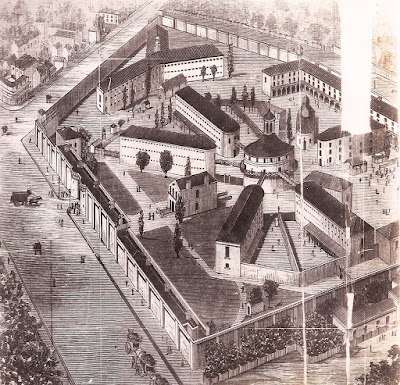 |
| Darlinghurst Gaol, 1874 from Illustrated Sydney News |
Week ending 1 June 1878 - Government Asylum Liverpool
Luke Lawrence
Age 61
Admitted by Manager
1 August 1885 - Death.
Certificate was issued at the George Street Asylum (Hospital) , Parramatta.
"On 13 March 1862 medical and administrative personnel were appointed to George Street Asylum, Parramatta, which began functioning as a Government Asylum for infirm and destitute men following the findings of the Report from the Select Committee on the Benevolent Asylum, Sydney, and subsequent Government assumption of responsibility for provision for the infirm and destitute. Previously the Committee of the NSW Benevolent Society had maintained asylums at George Street, Sydney and at Liverpool. The main building of the George Street Asylum was completed in 1824 and had functioned as a barracks for the military, and later for convicts." (Source: https://researchdata.ands.org.au/george-street-asylum-1913-1936/165676)
Register of Coroners’ Inquests
Luke Lawrence
Number of Inquest 275 (not digitised - would have to pre-order and visit the State Archives to read)
Eliza Lawrence nee Franklin (3 x great grandmother)
(from Elizabeth Lahiff)
 |
| Eliza Lawrence née Franklin |
Eliza (called Liza) was a tall, good looking woman, with a pleasant kindly face. She appeared to be rather naive as the following stories indicate.
Soon after their arrival in Australia, when the family was living in Hunter Street, Sydney, Luke her husband and another married man went off to search for gold, leaving their wives and children. They did not make their fortune on the goldfields and returned home to Sydney. On their return Liza remarked “there was no need to search for gold - there was plenty in Sydney, and that their neighbour had found some.” It appears the lady , whose husband had accompanied Luke to the goldfields had been “on the town”, but Liza was quite unaware of this, and by her remarks caused a serious quarrel.
Another story is that she was spending some time in London with a relative, who was either a tailor or a bootmaker, and who had the Duke of Wellington as a customer. One day when the Duke was expected, it was suggested she look out of an upstairs window to see the Duke who was a national hero, having saved England from Napoleon and the revolutionary French. When the Duke of Wellington arrived, Liza said in a loud voice “Hasn’t he a large nose”, at which the Duke looked up and said “Yes, madam.” There was much concern in the family, who feared she had insulted the Duke.
Although living conditions were difficult in Sydney some goods were cheaper to buy than in England. Tea was 2 shillings and 6 pence a pound in Sydney compared to 10 shillings in England. When Liza asked the shopkeeper for a quarter of a pound of tea, he said “You are new in the colony”. “Yes” she replied, “I will have 2 pounds of tea.”
Efforts were made to conform to the social customs of England, no matter what the cost of food. For example, beans had to be eaten with roast beef, peas with mutton.
Liza was apparently a gentle person, not suited to pioneering. Her daughter often said “I did not blame my father for leaving her - she was no pioneer.”
Liza was a very good needlewoman and supported her family by dressmaking. All her work was by hand and she did not attempt machine work.
It appears that some of the social life in Surry Hills was around St Michael’s Church of England church, which was built on land donated by a magistrate, merchant and politician George Hill. He lived in Durham Hall and had a dairy opposite the church.
 |
Durham Hall, currently owned and occupied by the Royal College of
Pathologists of Australia. It was built in 1834-35 for George Hill. |
 |
| Durham Hall now, after restoration. |
Liza, with her skill as a needlewoman and her association with the English gentry, was most likely considered a trustworthy person to enter the homes of people like George Hill, as dressmaker for his wife and daughters. Wealthy people imported boxes of fashionable clothes from London and Liza, among other work, would alter the fashionable clothes to suit the figures of colonial ladies.
Hill was born 25 March 1802 at parramatta, the son of convicts. He became a butcher and eventually had significant real estate holdings. He served on Sydney City Council from 1842 to 1851 and was mayor in 1850. He was also a member of the NSW Legislative Council from 1848 to 1849 and 1856 to 1861. He was married twice, and had ten children with his second wife. He lived at Durham Hall until his death on 19 July 1883.
Another family Eliza assisted with dressmaking was named Long, residing at Tusculum in Potts Point. He was a wealthy merchant with several daughters. One day he took Liza to one side and said he would show her an underground tunnel which led down to the harbour and which had been used for smuggling. Tusculum, an old mansion, was in poor condition but conservationists saved it from demolition, and the house has been restored. Some years later, as one story goes, Long’s daughters went to London to be presented at Court, but were prevented from this as a search of records revealed the father had been a convict. Smuggling was common and many tunnels were dug from houses to the waterfront. Tusculum is now owned by the NSW Historic Houses Trust.
 |
| Tusculum |
 |
| Tusculum |
Eliza Lawrence, born 1820 at Greenham, County Berkshire, died at her son Thomas’ home in Surry Hills on 19 July 1897, aged 77 years.
Eliza and Luke's children
Eliza and Luke Lawrence had 3 living children, Elizabeth, Thomas and James.
 |
| Elizabeth Susannah (Lizzie) Lawrence |
Elizabeth Susannah - , married Thomas Lutton. Thomas married another Eliza and they had one son, George.
James married Eliza Hind in 1883 and became a successful business man with a house painting and decorating business. He was active in the Labor Party and represented Surry Hills on the Sydney City Council for several years. They had 5 children.
Elizabeth (called Lizzie), born in Newbury on 12 December 1849, was named Elizabeth after her maternal grandmother and Susannah after her paternal grandmother.
She was three and a half years of age when, in June 1853, she arrived in Sydney with her parents and her brother Tom on the ship “Harriet”. Very little was said about her childhood. An intelligent child, she seemed to be educated by her grandmother, Elizabeth Franklin, for whom she had a deep affection. Formal schooling was confined to 3 months at a dame’s school. After this she refused to attend. Her love of reading assisted her self education.
Lizzie's memories and early life (as recounted by Elizabeth Lahiff):
The wreck of the “Dunbar” with the loss of all lives, except one, at The Gap, Watson’s Bay, Sydney. occurred in 1855. Elizabeth remembered riding in a cart along bush track to see the wreck. The 1850’s was a time of large emigration from England and the loss of the “Dunbar” upset the Sydney community very much.
In 1855 the first railway from Redfern to Parramatta was opened and she stated that she rode on an early train journey.

Left: Locomotive Number 1 (now in the Powerhouse Museum) - the first railway engine to haul a train on the Sydney to Parramatta Railway Designed and built in England by Robert Stephenson & Co., Newcastle-on-Tyne.
Vaucluse House was owned by the Wentworth family, with surrounding lawn established on soil brought from Ireland by a previous owner. It was said to have been blessed by Saint Patrick to keep the snakes away. She remembered being taken there as a child. Vaucluse House is now open to the public.
The family lived at Surry Hills, then a fashionable suburb of Sydney. On Sundays they attended St Michael’s Church of England church. Before leaving home the baked dinner was arranged in a baking dish and left at the bakery to be cooked in the baker’s oven, while the family attended church. After the service, the baked dinner was collected, a cover placed over it and the family hurried home to enjoy the traditional English Sunday dinner. Christmas cakes were also baked in the baker’s oven. Sydney homes, except those of the wealthy, had open fireplaces, with bars and/or moveable “arms” over the fire. Cooking was generally confined to boiling or frying.
When in her teens, Elizabeth commenced work in the home of George Hill, Chief Magistrate of Sydney. He had apparently moved from Durham Hall, near Flinders Street to Strawberry Hills, almost opposite the Devonshire Street entrance to Sydney’s Central Railway Station. The house later became Hendersons hat factory and may still stand behind the shops in Devonshire Street.
It was a wealthy household and Elizabeth seemed to be a companion to the Hill girls. When she was sixteen, Mrs Hill had become ill and so Elizabeth became their housekeeper. George Hill was so impressed wth her ability that he said that the family was to care for her all her life, and they did assist her after her marriage. She was influenced very much by the style of life and manners of the colonial society. So much so that she called her eldest daughter Nellie and her second daughter Florence after two of the Hill daughters. The Hill girls married into wealthy families, one became Lady Wentworth by marrying Fitzwilliam Wentworth and another Lady Cooper.
Another girlhood memory was swimming with the Hill girls at Nielsen Park near Vaucluse House on Sydney Harbour. The girls wore their underclothing and chemises; swimming costumes were unknown then. George Hill was considered by her to be a just, kindly person, but some histories of early Sydney state he was harsh in his sentences.
William and Sophia Franklin, Elizabeth’s uncle and aunt, took up their land grant named Wanganderry at Soapy Flats, on alluvial land, near High Range, Mittagong, in the Southern Highlands of NSW. William built a house from wooden slabs and roofed it with bark. While waiting for the farm to develop, he built bridges on the district roads. Elizabeth spent many holidays on the farm and thoroughly enjoyed rides in her uncle’s buggy in the scenic country. Often, she would talk about the view from Mount Gibraltar (Bowral) and the Fitzroy and Belmore Falls. During these rides she was at first scared of the goannas hanging from the trees.
Another favourite outing in the southern highlands was to Joadja, and the busy shalemines. Sometimes, they sat on kerosene boxes in the open railway trucks. She used to relate, with some embarrassment, how on one journey one girl’s dress was caught on a hook on the truck when she was trying to alight and she was left suspended in the air. This amused the train guard and she said “Little did I know he was to be my future brother-in-law, Bill Lutton.”
 |
| Elizabeth (Lizzie) Lawrence as a young woman |
William and Sophie had 13 children - 10 girls and 3 sons. This was a disappointment as the father was hoping for sons to help on the farm. From all accounts, the girls were very useful and helpful. Benjamin, the eldest son, died in infancy. George died from snake-bite aged 13. Arthur married Annie Kell, but I [ Elizabeth Lahiff] have no information on his family.
William later sold the farm and moved to Bowral where he died in 1906. Sophia lived on with a daughter and died in 1917. There are family records of their descendants which are too numerous to include here.
Elizabeth said that the train journey from Sydney to Mittagong was slow and uncomfortable with the wooden seats not designed for long journeys. One journey at Christmas time was exhausting, the bush was burning for miles and the carriages filed with smoke, as well as soot from the engine.
Life was hard in colonial days, but one did not hear that any of the family wished to return to England. The Franklins were country people, but even so, it required courage and hard work to pioneer in the rugged Australian countryside. Sophia, especially, was remarkable and resourceful. Granny was proud that she helped kill a big snake on one occasion.
Where Central Railway Station now stands was part of the Devonshire Street cemetery and the Lawrence and Franklin families often took a short cut through the cemetery from Surry Hills to Pyrmont and Ultimo. When it was decided to extend the railway from Redfern to the city, the graves were exhumed from the Devonshire Street cemetery and moved to Botany. Popular opinion of the day was that Central Station would be a white elephant.
Despite the poverty in colonial Sydney, where employment was not easy to find, many families maintained the manners of English middle and upper class society. They wore stylish, but not elaborate clothes, which were often hand sewn by the family. Table manners were important and children had to sit up straight, hold knives and forks properly, and be respectful to adults.
Social welfare payments were unknown. Aged and sick people were supported by the family, and it appears that the grandmother, maiden aunts, parents and children lived together for social and economic reasons.
 |
| Circular Quay from Pitt St about 1870s |
Small boats of ferries carried passengers from Circular Quay up the Parramatta River to Parramatta. It was not uncommon for the ferry to be caught on a mud bank in the upper reaches until the tide came in. Elizabeth, at 15, had her first long dress made for a ferry trip to Parramatta.S
Overcoats were unknown and not worn by women until the time of the 1914-18 war. Women wore jackets, long skirts or dresses with several petticoats, including a flannel one in winter.
The Franklins and Lawrences were proud of their place in English rural life. They were not from the aristocracy. The Lawrences claimed, rightly or wrongly, to be descended from Judge Jefferies, the “hanging judge” who sentenced the Duke of Monmouth to death (nothing to be proud about). Benjamin Franklin, the famous American scientist who discovered electricity, was a distant relative of the Franklin family.
Elizabeth Lahiff speculates that Luke may have received some money from his brother James' estate, after the unmarried James died in the US. Another family story was that there were advertisements in the Sydney newspapers seeking his relatives. Elizabeth heard a story that her brothers claimed and received some money from the estate, but did not tell her because she was a woman. This story was most likely imagination. Luke may have claimed and received benefit from his brother’s estate.
In her 20’s Elizabeth became friendly with two young men -
Thomas Lutton and Jack Ramsay. The trio went about together. A favourite outing was a Sydney harbour ferry ride on a Sunday afternoon from Circular Quay to Watsons Bay. A pleasant memory was the sound of the bells from St Mark’s Darling Point ringing over the Harbour.
In December 1876 Elizabeth accepted the proposal of Thomas Lutton and they were married quietly on 21 December 1876, when Lizzie was aged 27, by the reverend Henry MacReady, a Presbyterian Minister at his residence at Ultimo. One of the wedding presents was a set of Charles Dickens novels which was greatly appreciated as they were very keen readers.
 |
| Elizabeth Lawrence, later Lutton |
Elizabeth had a long life, bore 5 sons and 2 daughters and outlived her husband, who died in 1917, by 20 years. She died at Merrylands, a suburb of Sydney in September 1938, three months before her 90th birthday.
For information about Lizzie's life as part of the Lutton family,
see this entry.


 1833: The Factory Act restricted work hours for women and children. Mill owners were required to show that children up to age 13 received two hours of schooling, six days per week.

 March 1834: The ’Tolpuddle Martyrs' were sentenced to transportation for trade union activities.
 8 May 1838: People’s Charter advocated social and political reform on the basis of six points:


 1 May 1851: The Great Exhibition opened at the Crystal Palace in Hyde Park, London.

 24 November 1859: Charles Darwin's 'On the Origin of Species' was published.