
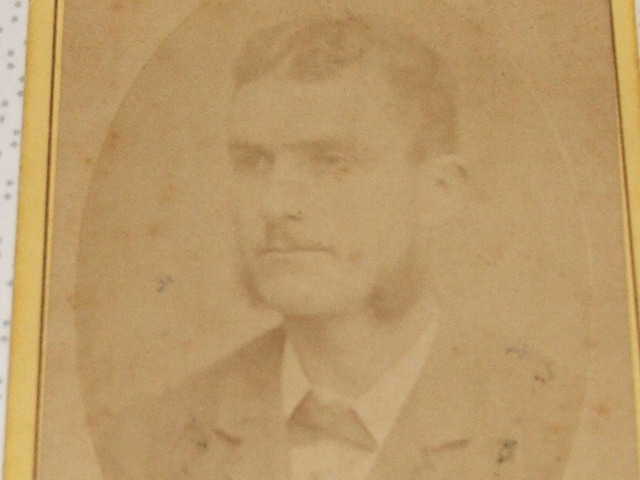
Charles Lutton and Margaret McBride (3rd great grandparents on Gwen Cant's side)
 |
| Charles William Lutton |
 |
| Margaret Lutton née McBride |
 |
| County Down 1810 |
The arrival of Luttons in Ireland
There is a tradition in Ireland that the first Luttons arrived in Ireland towards the end of the 17th century from England. The name is now relatively common in Ireland, especially in the north. Source
Betty Lahiff (1994), provides the following information:
"It has been said that William and Ralph Lutton went to Ireland with William of Orange, remained in the country, and inter-married with the Irish and became Irish. It is however, possible that they were in Ireland before William of Orange invaded the country. Charles William Lutton was descended from Ralph Lutton.
"The family history has it that in 1692 a family of Luttons were given a land grant in County Armagh after the Battle of the Boyne for “services to the king” (this is very doubtful)."
Charles’ father was John Wesley Lutton. He had a brother, Andrew James, who stayed in Ireland. Their Lutton forebears were:
- William Lutton (9th great-grandfather), born 1620 in Knapton, Yorkshire. At some point (after 1657) he moved from Yorkshire to Ireland; he died in 1688 at Moira, County Down.
- William’s son, William (8th great-grandfather), was born 1657, also born in Knapton, Yorkshire and died in Moira.
- William Junior had a son named James (7th great-grandfather) born in 1684 in Knapton. He died in Moira.
- James’ son, William (6th great-grandfather), was born in 1709 in Moira. He married a woman named Martha (6th great-grandmother) in 1735. They had nine children, one of whom was
- Anne (5th great-grandmother), born 10 Oct 1751 in Moira. She died 3 March 1816 in Donaghcloney. Anne married her cousin, Ralph Lutton (5th great grandfather) in 1770. Ralph was born in Moira in 1751 (died 8 April 1828).
- Ralph’s father, Ralph (6th great-grandfather) was born in 1723 in Moira (died 1778). He married Catherine Brown (6th great-grandmother).
 |
| Ralph Lutton's house at 65 Main St, Moira. Source |
 |
| Today the house is a Guest House |
Charles’ brother Andrew, and father John had a linen mill in Edenderry, a town in County Down, now on the southern edge of Belfast. Nearly every town and village had a mill or a factory. By 1921 there were almost one million spindles and 37,000 looms, with over 70,000 directly employed, representing 40% of the registered working population, with closer to 100,000 people dependant on the linen industry. At end of the 20th century only 10 significant companies, at most, remained employing 4,000 people.
The Craigavon Historical Society pubished a paper by an S.C. Lutton entitled The Linen Trade in Co Armagh since the turn of the Century. Lutton writes:
"Of the many handkerchief manufacturers in Portadown, Spence, Bryson & Co. Ltd. are the only survivors. Those that have long since gone, were William Cowdy of Edward Street, Thomas Dawson of Corcrain, A. J. Lutton of Edenderry and John Malcolmson of Windsor Terrace. This list is not complete as there were several other small firms operating in Portadown and the surrounding country.
"Edenderry village is situated approximately 4 miles from Belfast City centre on the County Down side of the River Lagan…During the first half of the nineteenth century, the population of Belfast quadrupled to more than 100,000 as commerce and industry expanded, and by 1816 most of the independent weavers had disappeared from the belfast market and were employed by manufacturers int he city. The townland of Edenderry lies in the Parish of Drumbo where there were between 400-500 linen cotton weavers in the 1830s…"Source
 |
| Edenderry |
Charles Lutton (source Elizabeth Lahiff, 1994)
"Charles was the elder son of John and Sarah Lutton. Charles was a quick tempered, lively boy, who refused to atttend school regularly, learned to read but not write. Part of his work in the family was to mind the flax.
"As a young man, he was in some trouble with the authorities, perhaps for some religious disturbance arsing from the bitter conflict betwen the Protestant and Catholic people in Northern Ireland. Together with a family friend, they managed to elude the police.
"Charles married Margaret McBride, a Roman Catholic born 1818 in Belfast, circa 1839. Her parents, Edward and Mary McBride were dead and she was listed as a house servant and laundress. Margaret was educated, it being unusual in Ireland of those days, for a girl to read and write. Even when an old lady, she read the newsapapaers to her impatient husband. She had one brother, Paddy, who was a Roman Catholic priest.
"Charles’ father, apparently very concerned about his son, offered to pay the fares to Australia of Charles, his wife and 3 children. Why Australia? This is not known, unless the family had some prior connection with the country. Emigration, under the revised Bounty system was just commencing. The time was just before the Irish famine of the 1840’s.
"As far as we can determine, Charles’ “crime” was in marrying a Catholic. He was obviously a person of character who defied the rigid conventions of the period and married Margaret McBride.
"In 1843 documents were signed for emigration to Australia. By now Charles and his family were living in Ballylough, a village of Bushmills in County Antrim, near Coleraine, some distance from Portadown. The emigration documents were signed in Coleraine. Emigrants were required to have evidence of baptism, health, character and probable usefulness in the colony. Charles’ application form was marked “good”. Religion was shown as “episcopalian”.
"Details of the family and their fares to Australia were:
Charles Lutton, aged 33 17.17.0 (pounds)
Margaret “ “ 25 17.17.0
Sarah “ “ 3 8.18.0
Edward (Ned) “ 1.5 8.18.0
Mary Anne “ 2 months under age
Charles and Margaret Lutton come to Australia
 |
| HMS Herald |
"It was the custom for young women alone to be under the care of a responsible adult. Charles Lutton had two young women in his charge, by decision of the agent. They were Jane Mahon and Anne Ritchie, one a nurse and one a laundress. At the end of the journey it was noted - “They behaved themselves very well”.
"The voyage of the Herald appeared uneventful. It was a crowded ship but very clean, with excellent provisions, and no complaints.
"The ship arrived in Sydney on 10 January, 1844 and was inspected by the Immigration Board on 11 January before the passengers were let ashore. The report comments on the excellent supervision of Doctor Sullivan, the ship’s Surgeon Superintendent, which ensured the health of the passengers. It states, inter alia, “The orderly, contented, cleanly and healthy state in which (they) arrived, reflect the highest credit upon Doctor Sullivan, the Surgeon Superintendent, who appears, though a strict disciplinarian, to have enjoyed the regard, as well as confidence of those placed under his charge.”
Family history researcher, Ron Lutton, has written this imaginative piece about the emigration of Charles and Margaret Lutton, with their three eldest children.
A FUTURE BEYOND
Ron Lutton
2011
Feelings of exhilaration and trepidation must have swept through the Bounty immigrants
aboard the “Herald” as it entered Sydney’s harbour on that January morning in 1844. For
those old enough to remember the loved ones, friends and homes left behind in Northern
Ireland, their feelings must have been tinged with sadness. Yet all would have found
relief in the thought that they would soon be stepping onto dry land, the first time in three
months since setting sail from Greenock in Scotland. For some, there would have been
the excitement of starting a new life in the far-flung British colony of Sydney, Australia.
Among the immigrants, no doubt with mixed emotions, were my forbears Charles and
Margaret Lutton, and their three young children. After sailing from Belfast in Northern
Ireland, they had joined the ship in Greenock to seek a new life in a far away country.
The “Herald” of 911 tons had sailed from Greenock on 10 October 1843 with 313
immigrants aboard and arrived in Sydney Harbour on 10 January 1844. Being built in
1840 in New Brunswick, Canada, the “Herald” was one of the newer types of the many
sailing vessels contracted to carry immigrants from the United Kingdom to Australia.
The sea journey of over 9300km was accomplished in the very favourable time of 91
days without making landfall until reaching Sydney. The ship’s return records that 313
immigrants arrived under the Bounty System, comprising 56 families with 110 children
under 14 years of age, 21 of these being less than one year old; 47 unmarried males over
14 years of age; and 44 females over 14 years of age. They all arrived in good health
although during the voyage there had been three deaths. There were also five births
during the voyage.
The first sighting of the east coast of Australia must have raised some alarm with the
immigrants when they saw small fires along the coastline. At night the small fires would
glow red along the coastline and during the daytime smoke could be seen rising above the
harsh bushland that lay beyond. The threat of Aborigines would have become more real
as many stories had filtered back to the old country about the danger they could pose to
the new settlers.
As the “Herald” entered Sydney Harbour it was met by the pilot boat with its quarantine
officers aboard to check the health of the crew and passengers. The ship’s return reports
that the ship received a clear bill of health from the harbour authorities and was allowed
to proceed to dock and unload its cargo. The “Herald” docked at Campbell’s Wharf and
the following day started to unload its cargo of glass, confectionery, bales of linen,
leather, soda ash, boxes of apparel and many other items.
The immigrants however, had to wait aboard ship until their sponsor arrived to take them to their place of employment. Some journeyed as far away as Bathurst while others were taken into employment by the Sydney colonists. Charles Lutton had somehow arranged temporary employment with the government prior to commencing the voyage and remained in Sydney.
All of the newcomers found employment within the week.
Importantly the ship brought new immigrants to the colony, but it also brought news from
the outside world. Many in the colony craved for news from back home and the “Herald”
brought them relief in the form of newspapers from London and Scotland, albeit three
months old.
The colony had to rely on the shipping to bring the news from the outside world and
importantly to report back to the world the colony’s progress. The mood in the colony
had been depressed for several years at that time, mainly due to the poor wool prices in
the fledgling wool industry. The Sydney Morning Herald, the day after the “Herald’s”
arrival, reported that the news in the overseas newspapers had been encouraging in that
overseas trade was continuing to improve, especially in wool trade. The Sydney Morning
Herald also reported that the immigrants arrived in a healthy condition giving credit to
the ship’s surgeon superintendent, captain and officers, and the superior ship’s fittings.
These the paper reported were superior to any emigrant vessel that had ever arrived in the
colony having two-tiered berths round the ship and nine feet (2.7m) between decks.
Single males were housed in the fore part of the ship, the single females in the aft section,
and the married couples placed amidships.
But what could have induced the young Lutton family to leave their home and family to
seek a new life in Australia, so far away across the world? Charles was 33 years old,
Margaret 25, and the children, Sarah 3, Edward 2, and Mary Anne 2 months. Charles’s
occupation had been a farm labourer/horse keeper and Margaret a house servant.
Imagine the difficulty of sailing for three months in what nowadays we would consider to
be horrendous conditions. These were times when some people didn’t survive such a sea
journey. The incidence of plague and other incurable diseases were a real threat.
Numbers of ships arriving in the colony had to first unload their sick passengers at the
North Head quarantine station before being allowed to proceed to dock or tie up in the
harbour.
The question as to …“why would they want to do it” …had been posed in my mind for
some time since I first started looking into my family history. It wasn’t until I started
corresponding with Doctor Samuel Lutton living in Belfast, Northern Ireland in 1990,
that the answer was revealed to me - religious bigotry!
Charles was a Protestant and he had married Margaret who was a Roman Catholic. A mixed marriage in Northern Ireland back in that time meant the couple, and their young family, would have had no future living there. Samuel Lutton said that such a marriage even in 1990 would have serious consequences. Living in Australia today, it’s hard to imagine that the feelings associated with religious bigotry could be so strong, although one only has to remember the killings in Northern Ireland in recent decades.
After arriving in Sydney, Charles and his family lived for a short time in
Woolloomooloo, later moving the family to the then more prosperous area of Paddington.
The family grew from there and is now spread throughout eastern Australia.
Researched and written by Ron Lutton, 9 May 2011
Employment on arrival
Betty Lahiff says:
"“The superiority of the emigrants by the ‘Herald’ is plainly proved by the fact that they have all found employment, notwithstanding that there are said to be 2,000 adult males now unemployed in Sydney, the refuse for the most part of the former immigration.”
Charles Lutton was taken into temporary employment by the Government. Bounty immigrants, whose fares were paid by the British Government were bound to an employer for 12 months. Charles Lutton was free from this obligation as his father had paid the fares of the family.
Lutton’s name does not appear with the other passengers as having entered an employment agreement.
“ [..] the three men shown in the foregoing list to have been taken into employ by the government, two were unable to proceed up the Country in consequence of the [..] consent of their wives. The third failed to obtain an engagement in consequence of [..] with three young children in addition probably to inferior qualification [..] it [..] all his proof of (writing?) [..] from his arrival. [..] may mention that married men with young and useless children find great difficulty obtaining employment, and that with Mechanics, Artizans and Tradesmen of every description the labour market is at present overstocked & is likely to remain so until the Colony has fully recovered itself.
“The wages given to Labourers and Shepherds will be seen to be considerably lower than those [..] Immigrants who arrived in 1842 but the price of clothing and provisions to have [..]
[Can’t decipher next part]
“I beg to [..] for the [..] information of the [..] a copy of Report of Immigration Board.
“The only defect observed by the Immigration Boar on the ship “Herald…the absence namely of Stern ports was so fully compensated by her [..] her height between decks, and her general suitableness to the service, the mention is scarcely necessary - [..] however observes that the defect was in great measure remedied by a Wingrail which the Surgeon saw to be fitted through a small scuttle on the main deck corresponding with a ship light on the Poop deck immediately before the wheel. By this [..] a current of air [..] was introduced into the female hospital at the after front of the ‘tween decks.
“ The fittings of the ship and the general arrangements on board were unexceptional.
“The provisions proved to have been of excellent quality, and not a single complaint was made by the Immigrants respecting either their quality or their [..]
“The orderly, contented, cleanly and healthy state in which the Immigrants arrrived, reflects the highest merit upon Dr Sullivan, the Surgeon Superintendent who appears, though a strict disciplinarian, to have enjoyed the regard as well as confidence of those placed under his charge. His attention to the interests of Immigrants in making their engagements here has also been most praiseworthy. We need desire no more than that ther emay be found in all cases Gentlemen equally qualified by age, by experience, and by the other usual qualifications requisite for the effecient discharge of the duties of Surgeon Superintendent.
“I have taken the liberty of particularizing age amongst Dr Sullivan’s qualifications, that I may follow it up by an expression of hope that Gentlemen under the middle age may as far as possible be excluded from these appointments.
“The self confidence and self possession necessary to establish his influence (over?) a large heterogeneous body of people, and to enable him to act independently of the Master of the Vessel, will rarely, I fear, be found in a very young man, even though he may have the advantage of some experience in his particular Service.
“ The insertion of this general remark here, I feel requires apology, but it will doubly be excused by the Commissioners when they consider how painful it would be hereafter to point it at some individual whose exertions may have been most praiseworthy and whose success in the Medical department of his duties may have been com[..].
“No disease of consequence occurred during the voyage.
“The quality of the Immigrants generally was highly satisfactory and the [..] between them and those to whom the Colonists had been latterly accustomed did [..] to [..]
“Like the Public as well as the Board
X 9 February 1844 "
The Lutton family grows in Australia
Whatever the fortunes of Charles and Margaret upon arrival, life was very hard. Charles worked as a carpenter (Lahiff)
After their arrival with the three “useless” children, Charles and Margaret went on to have 11 more.
The family, moved around the inner east of Sydney. In the Sands Directories for 1887, 1888 and 1889 their address was 10 Prospect St, Paddington. In 1890 it was 35 Little Underwood St; 1895 - 25 Glenmore Rd. In 1897 and 1898 their address was 152 Forbes St, Woolloomooloo.
Margaret died on 11 June 1898, Charles three days later on 14 June. They are buried at Waverly Cemetery. In the death record index for Charles, it names his parents as Andrew J and Ann, the informant may have mistaken his uncle and aunt for his parents.
Time in Queensland
"After Thomas's birth in 1852, Charles and Margaret and their 6 children travelled to Queensland, lived in Brisbane and possibly Gympie or Port Curtis (near Gladstone). In 1854 Maurice O’Connell (the younger) became Governor resident in Port Curtis and it seems likely that the Luttons were part of the group of people going north with him. Maurice O’Connell was a grandson of Governor Bligh. His mother Mary Putland (nee Bligh), a widow, defied her father and married Colonel Maurice O’Connell who came to Sydney with Governor Macquarie as his adjutant.
The Luttons lived in Brisbane for a while but lack of work forced ther return to Sydney. Margaret bore one or two children in Queensland, while living in a tent. Food was in extremely short supply and Charles said only the German immigrants growing vegertables saved the people from starvation.
Sarah, the eldest daughter, about 13 years old, remained in Brisbane in the "household" of Maurice O’Connell. Some years later she married Charles Baldwin the parliamentary caterer, an Englishman of some means. "
 |
| Cabbage tree hat NSW 1880s (Museum of Applied Arts and Sciences |
"Living for people with big families was extremely hard. Margaret helped by making cabbage tree palm hats and each child was given a length of palm to plait each day. Cabbage tree palms grew in abundace in Sydney.
 |
| Paddington National School 1856 |
"They struggled very hard to educate their children who attended Paddington Public School. The sons learned trades, no small achievement in those days. John became a printer, Charles a watchmaker, William a railway guard and James a draftsman. Thomas, after leaving school, attended evening classes for intelligent boys conducted by Judge Stephens in his home and entered a lawyer’s firm, to train in law. His father was now elderly and could not support Thomas who received no salary. The legal training was abandoned and he turned to other occupations, mainly clerical.
 |
| Paddington 1842 (State Library NSW) |
"At one time Charles appealed to his wealthy brother in Belfast for help, only to receive the reply - “You have been in the colony long enough to be driving around in your own carriage with your own coachman.” This so infuriated the family that it was resolved not to ask for help again. However, some contact was maintained and books and poems written by Anne Lutton were received. Anne Lutton (1791-1881) was an intellectual religious figure of her time, deeply religious and regarded as as a saint and poetess. Her Lutton Birthday Book is artistic with her poems and illustrations. Anne moved from Ireland to England and spent much of her life working among the poor people, especially women and children. There is a memorial to her in St Mary’s Church, Bristol. A stained glass window is now in the possession of Dr Abraham Lutton of Oswestry, Shropshire, England."
"Charles Baldwin, Sarah’s husband, visited the family in Belfast, where he was coldly received until they realised he was prosperous and required no assistance from them. He returned home with some fine linens, no doubt paid for at market prices.
Charles built a small house at 152 Forbes St, Woolloomooloo and lived there for some years with Margaret and their unmarried children."
Sarah, the eldest child was born in County Down, Ireland on 27 May 1840. She died in Brisbane on 9 January 1878, at the Parliamentary Refreshment Room, of peritonitis.
Sarah’s marriage to Mr Charles Baldwin took place on 4th May, 1867 at St John’s Church, Brisbane. It was announced in the Sydney Mail on 18 May. She is buried in North Brisbane General Cemetery.
Sarah and Charles had seven children, who variously married and had children of their own.
Edward was born on 7 November 1841 in County Down, Ireland.
Edward married Rachel Woodend in St George in Sydney. They had 4 children between 1873 and 1883. None of them lived in to old age. Agnes was 26 (1899), William 17 (1893), Elsie 2 (1885) and Alice 31 (1906). All pre-deceased their parents.
He fought in the Maori War in New Zealand and lost a leg. He brought home a green stone Maori axe, given to him, or taken from a Chief as the Chief was dying. (Lahiff)
Edward died at the Rookwood Asylum, Lidcombe on 27 Feb 1919. In 1913, the Asylum had became known as Rookwood State Hospital and Asylum for the Aged and Infirm. It is possible that he was suffering some kind of dementia. Eventually it evolved into Lidcombe Hospital.
Edward is buried at the Rookwood Cemetery.
 Mary Ann was born 2 July 1843 in County Down, died 19 December 1922 in Rochford Private Hospital, Wickham Terrace, Brisbane - age 79.
When sister Sarah died in 1878, Mary Ann went to Brisbane to housekeep and care for her sister’s children, who were aged between 9 months and 10 years of age. She married her widowed brother-in-law, Charles Baldwin, on 4 December 1880, and they subsequently had two daughters - Violet Sarah, born 23 July 1883 in Brisbane, and Ruby Eugenie, born 11 August 1885 in Brisbane.
Violet married Arthur Wesley Fox on 25 March 1911 and had a daughter, Ruth Mary, born 7 March 1914, died 10 March 1914.
Ruby married John Hamilton Beath on 23 May 1907 in Qld. They had a daughter, Mary Hazel, born 21 January 1908, and son Charles Hamilton born 14 April 1909.
William was born on 16 June 1845, Paddington and died 21 April 1874, Sydney Infirmary, age 29. He was a railway guard, who died in an accident at work. The Inquest into his death found he died of shock and loss of blood and injuries received in a shunting accident at South Creek.
William had married Lydia Hannan (born 18 November 1859) in 1869 in Sydney. They had two children. Edith Louisa, born 1871 died in 1874 and Charles David born 1873, died in 1877.
Jemima was born 11 May 1847 in Paddington, died of tuberculosis on 4 August 1848 in Paddington, aged 15 months.
John Henry, born 15 March 1849, Paddington, died 8 October 1868, in Brisbane - age 19 and is buried in the Church of England cemetery in Brisbane. He died of Phthisis, which is now called tuberculosis. He had been living in Brisbane for 5 weeks prior to his death; he had probably gone to his sister Sarah’s for the warmer climate. [Lahiff says he died of drowning on a Sunday School picnic at Nielsen Park]
Charles was born 6 January 1851 in Paddington and was christened on 9 March 1851 in the Parish of St Mark, Alexandria. He died in Paddington in 1872, Paddington, aged 21.
Thomas (great-great grandfather) was born 16 September 1852 in Paddington. He was christened 7 November 1852 in Parish of St Mark, Alexandria.
Thomas married Elizabeth Susannah Lawrence (great-great grandmother), born 12 December 1849) on 21 December 1876 at Crown St, Ultimo.
Thomas died 24 September 1917 at “Montrose”, 99 Gordon St, Paddington and is buried at Waverley Cemetery in the Church of England section. He died of acute lobar pneumonia and cardiac failure.
?? Agnes, probably born in Queensland.
Frederick, born 1854, suggested in Queensland, though I can see no record in either NSW or Queensland. Died aged two on 26 March 1856 in Gipps St, Paddington and buried at Camperdown. He was last seen by Surgeon Hoffman, 11th Regiment on 26 March 1856 who diagnosed his 3 month illness as whooping cough.
Alexander, born 1858 in Paddington, died 26 April 1859 at Gipps St, Paddington, aged less than one year. He is buried at Camperdown, as is older brother Frederick. Alexander died of inflammation of the lungs, which illness lasted 3 days.
George, born 1859 in Paddington, died 4 April 1872 in Prosepect St, Paddington. Cause of death was typhoid fever, perforation of the intestine, an illness he suffered for 2 weeks.

Fanny nursed and cared for her parents at Forbes St, Woolloomooloo.
Emily Margaret, born 1864 in Paddington, died 13 December 1865, aged one year at Prospect St, Paddington. She suffered from bronchitis for 3 days.
Charles' and Margaret's lives were punctuated by the deaths of nine (or ten?) of their children, in 1848, 1854, 1859, 1865, 1868, 1872, 1874, 1878 and 1894. It is hard to imagine how this would affect you, but just visiting cemeteries of the era attest to the prevalence of early mortality.
Much of the information about the Luttons comes from A Family History of the Freeman, Franklin, Lawrence and Lutton Families by Elizabeth Lahiff, April 1994.


