Showing posts with label John Fairfield Moore. Show all posts

Saturday, June 1, 2019

4. The Moore family becomes established in Ilford area, NSW

In one generation, the Moores went from being convict and free immigrants to land-owners and established residents in the Ilford area of the Central West of NSW. We must bear in mind that they were the beneficiaries of the massacres of the original inhabitants of the land, the Wiradjuri people. 

Their prospects and fortunes, apart from a few minor brushes with the law, far outstripped their compatriots back in Ireland. They had been establishing themselves in trades and as farmers during the years of the Potato Famine back home. The 1860s in Ireland saw an increase in political activity aiming towards Home Rule. In 1858 in the US, John O'Mahony founded the Fenians, a secret militant organisation echoing in its name the Fianna - the warrior band of the legendary Celtic hero Finn McCool.
 
A branch is founded in Ireland by James Stephens, whose Irish Fenians call themselves the Irish Republican Brotherhood. In Ireland during 1867 various ineffectual attempts at uprising are put down Nevertheless there are explosions, violent deaths and executions as Fenians try to spring their arrested colleagues from police custody. 

Read more here 


At the time this was going on, twelve thousand miles away the Moores were buying land in Ilford (then called Kean's Swamp) and nearby.

Laurence Moore 1783 Queen's County/Laois, Ireland - 1836 Mulgoa, NSW (4th great grandfather)

On his arrival as a convict Laurence worked at Harrington Park as an assigned convict. After Mary, Daniel and John arrived, he was assigned to Mary, and they resided in Sydney. In the 1828 census they were living in George Street.  At that time he was an assigned servant, working as a labourer, but also had three head of cattle and employed a labourer named Patrick Murphy. (Piddington)

In 1836 they appear to be still living in Sydney, because Laurence is twice recorded as entering Sydney Gaol.

Laurence is recorded as entering gaol in January 1836. He was 5 ft 7 inches tall, stout, with a pale complexion, grey hair and hazel eyes. He had a tattoo of "mother" on his chest with a crucifix. The does not appear to be any detail about what he was in gaol for.

In March he was arrested for allegedly having stolen a hat from John Monk near the Market Wharf on Darling Harbour. The two men were walking together along Sussex St late on the evening of 28 March when the alleged offence occurred. Laurence was sent to Sydney Gaol on 30 March to await trial which took place on 23 April. He was found not guilty.

The description of him on entry to gaol was that he was grey-haired with a pale complexion. His occupation was labourer, and his year of birth given as 1783.

Not long after, Laurence died. His death is listed in the Register of Coroners' Inquests for 27 November 1837. Cause of death was given as "Visitation of God", which meant "natural causes" in today's parlance. There is no record of a Death Certificate.

He was buried at Sir John's Cemetery in Regentville, not far from Mulgoa. His headstone was inscribed:

"Erected by Michael Moore in
Memory of his father
Laurence Moore Who
Departed this life on
The eighth day of October
1836, aged 53 years.
Request in pace"


The cemetery where Laurence was buried was established by Sir John Jamison, owner of Regentville estate, for his Irish tenants. It was also used by other Catholic families in the area. It was situated on a hill overlooking the Nepean Valley and Blue Mountains. It is located in Lilac Place, Jamisontown.
Source: Penrith City Local History website 

Cemetery from Google maps
Mary Moore 1788 Ireland - 1852 Penrith NSW (4th great grandmother)

As little is known of Mary's life after her arrival in Australia as before.

Mary and Laurence had a daughter, Mary, born in Sydney the year after her arrival. She and Laurence were sponsors at the baptism of James and Margaret Russell's son John in September 1832 and Mary witnessed the marriage of her son Michael to Maria Ring in March 1834.

She seems to have been living with Michael and Maria at Mulgoa at the 1841 Census. The entry for the family includes a woman aged between 45 and 60. Mulgoa is not far distant from where Laurence was buried.

Mary Moore of Mulgoa was buried on 19 November 1852 by a Catholic priest, Michael Brennan, somewhere in the parish of Penrith. The burial register includes a ship's name Thames of London. It is not known in which cemetery she was buried, but as Michael erected a headstone to his father at St John's Cemetery in Regentville, near Mulgoa, she may have been buried with Laurence. 

Moving west 

Aboriginal Land

Laurence and Mary's sons Daniel, and then Michael, were the first of the Moores to buy land in Ilford in 1860 and 1861 respectively. 

The first Australians from this area are identified as the Mudgee and the Dabee people and are clans of the Wiradjuri nation.
A massacre has been documented at the Turon River on 1 September 1824 when a three-pronged attack by armed soldiers in daylight took place. 45 Wiradjuri men, women and children were driven into a swamp and killed.  Another took place in the vicinity of Rylstone on 5  -10 September 1824, when Chamberlaine, William Cox's overseer at Mudgee and two stockmen killed 16 Wiradjuri, probably all men, including a leader known by the settlers as Blucher. Source here.  

Blücher was a Prussian Field Marshall, an ally of the British, who earned his greatest recognition after leading his army against Napoleon at the Battle of The Nations at Leipzig in 1813 and the Battle of Waterloo in 1815. According to his biography in the Encyclopædia Britannica Eleventh Edition (1911), Blucher retained, to the end of his life, the wildness and tendency to excesses which had caused his dismissal from the army in his youth, but these faults sprang from an ardent and vivid temperament which made him a leader of people. While by no means a military genius, his sheer determination and ability to spring back from errors made him a competent leader. A popular German idiom, ran wie Blücher ("charge like Blücher"), meaning that someone is taking very direct and aggressive action, in war or otherwise, refers to Blücher.

A curious nickname for the British colonists to give an Aboriginal Elder, perhaps signifying some respect? 

Introduced diseases and illnesses also took a severe toll. The Rylstone history webpage also adds: 
"Dislocation of Aboriginal culture...advanced rapidly. The last coroborees known in Rylstone or its hinterland were held on the Mudgee hills in the 1850s. The dramatic increase in European population as a result of the gold rushes in the 1850s forced many Aboriginal peoples to retreat to the plateau above Hill End and exacerbated their alienation from traditional hunting grounds and campsites."

Bourke by Martin Archer Shee (c. 1837–1850)
On 26 August 1835, the Governor of NSW, Sir Richard Bourke issued a proclamation through the Colonial Office which implemented the doctrine of terra nullius by proclaiming that Indigenous Australians could not sell or assign land, nor could a person acquire it, other than through distribution by the crown. This principle, that there was no land ownership in Australia prior to settlement by the British Crown, stood until the Mabo Decision of the high Court in 1992.

The proclamation was prompted by John Batman, who when establishing a settlement which is now Melbourne, agreed to a treaty with the local Aboriginal inhabitants. Bourke's proclamation effectively declared Batman's treaty null and void and implemented the concept of terra nullius.

In other ways Burke was reasonably enlightened: he abolished the established church - the church of England, and gave all churches equal footing, and he was keen on the emancipation of convicts. Although a British Army officer, he was Irish-born, and a Whig. 

Laurence and Mary's descendants 

1. Michael Moore 1810 Laois, Ireland - 1872 Ilford, NSW (3rd great grandfather)

Michael married Maria Ring (3rd great grandmother - see separate entry) at St Mary's Church in Sydney on 16 March 1834. Maria arrived from Ireland as a 21 year old servant on the Red Rover, a 'bride ship' in August 1832. 

Michael and Maria spent the first few years together in the Mulgoa / Penrith / Windsor / Emu Plains district, during which time their six sons were born. 

At the 1841 Census, the Moore family were residing at Henry Cox's property "Glenmore", Mulgoa. There was also an older woman, most likely Michael's mother Mary. 
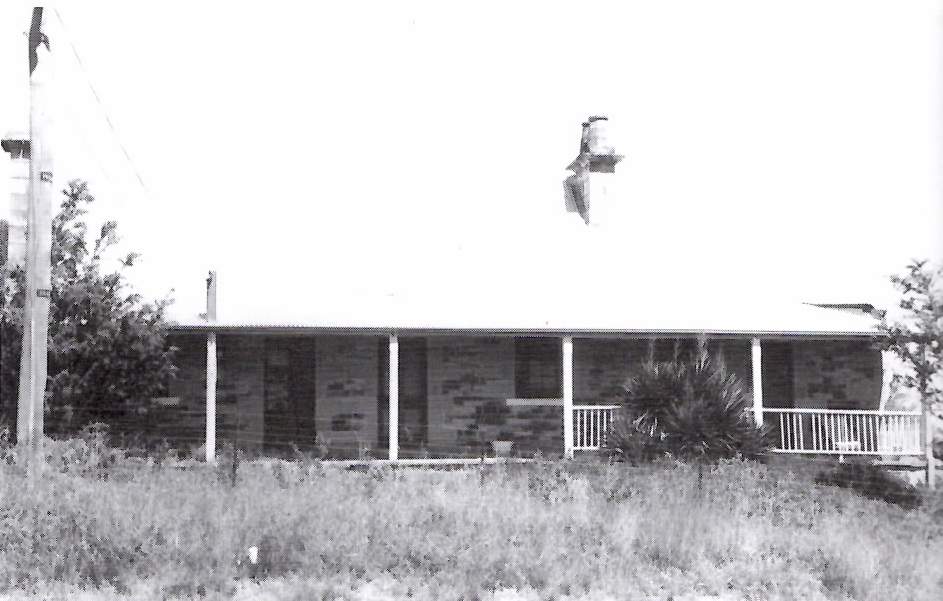


House which was the Plough Inn
In 1857 and 1858, Michael held the licence for the 'Turon Inn' at Running Stream on the main road between Mudgee and Sydney. In 1861 he opened the 'Plough Inn' at Kean's Swamp (as Ilford was then known). On 16 July 1861, Michael bought a forty acre block to the west of the village at Tara Creek. Michael farmed that land as well as running the inn. He was variously described as an 'inn-keeper' and 'farmer'. His sons also bought neighbouring blocks. They and their descendants were farmers and carriers, farmers and bee-keepers, farmers and mail-contractors, farmers and butchers, farmers and prospectors. 

Michael died on 26 September 1872, aged 62. 

Ilford Cemetery, general view
Maria outlived him by 20 years, and also outlived three of her six children. She died on 16 April 1895 aged 87. She and Michael are buried together at Ilford Cemetery. 


Children of Michael and Maria née Ring

Michael and Maria's six sons all married, mostly to young women from the Ilford area. 

John Fairfield and Catherine (née Byrne)
  • John Fairfield (2nd great grandfather), born 1835 in Windsor, died 10 June 1869 at Round Swamp, married Catherine Byrne (2nd great grandmother) - see next chapter, born July 1833 in Carlow, Ireland, died 8 April 1914 at 'Tara', Ilford, aged 83.  John and Catherine remained at Round Swamp for the first few years. In 1862, he bought two blocks totalling just over 40 acres not far from his father's farm on Tara Creek, and named the property "The Willow", John died of a "low fever" at Tara Creek in1869 aged 34, leaving Catherine with seven young children. With the help of her sons, Catherine kept the farm going.  The eldest, Johnny, was 13 when his father died. Johnny lived to 91 years of age, and never married. he remained on 'The Willow' for most of his life, as did his brother Thomas "Dadder"(great grandfather), who married Fanny Weatherly (great grandmother) in 1893. They had 14 children. The property was enlarged by further purchases. Additional sources of income for the large family included the mail run between Ilford and Sofala.                         

  • Laurence Ring, born 1835 at Mulgoa, died 28 March 1908 at Lithgow, married Esther Piesley in 1861, and following her death, Mary Finn in 1894
  • Thomas, born 1836 at Mulgoa, died 1876 at Rylstone, married Frances Fitzpatrick in 1860. He died of typhoid and was buried at Ilford.
  • Michael, born about 1840 at Mulgoa, died 1919 in Inverell. He married Eleanor (Ellen) Barnaby, daughter of an Inn-keeper at Round Swamp in 1866. 
  • Frederick, born 13 September 1842 at Penrith, died 1893, married Anne Murray, daughter of a local farmer. They later moved to Queensland. 
  • Robert, born 1845 at Emu Plains, died 9 April 1907 at Lithgow, married Harriet Giles, daughter of a local farmer and sister of Bridget Giles who married his cousin Daniel Bede Moore. Robert also died of typhoid and was buried at Bowenfels. 
Children of John Fairfield and Catherine (née Byrne)
  • John (Johnnie), born 12 December 1855 at St Marys, died 5 November 1946 'The Willow', Ilford. Never married.
  • Michael, born 11 August 1857 at Round Swamp, died 1908 at Ilford
  • Maria, born 1 May 1859 at Round Swamp, died 1939 at Parramatta, married Samuel Stackpoole
  • Thomas "Dadder" (Great Grandfather), born 21 February 1861 at Round Swamp, died 2 November 1935 at Mudgee, married Fanny Weatherly, born 1872 Rylstone, died 6 July 1949 at Kandos. They had 14 children! One of them was Thessel Agnes - Tessa- (Grandmother) who married Ted Briggs. 
Tom and Fanny Moore and the girls in the family

  • Robert Lawrence (Bob), born 16 December 1863 at Kean's Swamp, died 24 October 1949 at Rylstone, married Hannah Russell
  • Daniel Joseph (Dan), born 12 January 1866 at Kean's Swamp, died 11 July 1945 at Ilford, married Catherine Minehan
  • Mary Bridget, born 8 May 1868 at Rylstone
  • Agnes, born 1869 at Kean's Swamp, died 1959 at Rylstone, married James Guthrie
Dan, Bob and Johnnie Moore
Children of Thomas "Dadder" and Fanny née Weatherly

     (i)    Percy Hayden, born 1893 at Rylstone

Mel and Hayden Moore

     (ii)   Norman Thomas, born 1895, died 1980

Norman Moore

Norman and Eileen with children Bernard and Yvonne

    (iii)   Hilda Celestine, born 1897 at Rylstone, died 1944, married Thomas Partlett
    (iv)   Volney George, born 1899 Rylstone, married Kathleen Ritchie
    (v)    Thessel Agnes 'Tessa', born 27 February 1901 in Rylstone, died 8 August 1959, married Ted Briggs

Wedding of Tessa Moore and Ted Briggs at Moore house, Ilford

Tess Moore and Ted Briggs wedding

Tessa and Ted Briggs in the 1940s
Tessa Briggs née Moore


    (vi)   Daphne, born 1903 at Rylstone, died 1994 at Rylstone, married Douglas Neil Mills

Daphne Moore

    (vii)  Sylvia Mary, born 1904 at Rylstone, died 2001, married Earl Reynolds
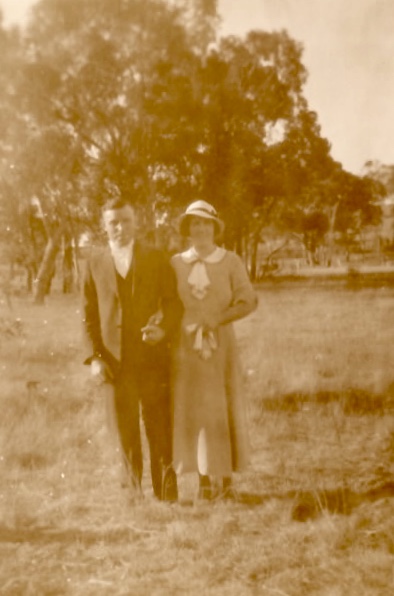
Mary Moore and Earl Reynolds

    (viii) Doris Valerie, born 1906 at Rylstone
    (ix)   Colin Ernest, born 12 January 1909 at Rylstone, died 1997, married Marjorie
    (x)    Kathleen Beatrice, born 1910 at Rylstone
    (xi)   Irene, born 1912
    (xii)  Veronica Catherine, born 1914 at Rylstone, died 1994 at Mudgee
    (xiii) Iris J, born about 1916 at Rylstone
    (xiv)  Mavis E, born about 1918 at Rylstone

Daphne, Doris and Mary Moore. Baby ? 

2. Daniel Moore 1812 Ireland - 15 July 1868 Ilford, NSW (4th great uncle)

Daniel was apprenticed to James Russell as a blacksmith at the 1828 census and continued in that trade all his life. It appears he spent several years in the Maitland district, then moved to Mudgee and later to Ilford. 

Daniel's wife was Margaret Russell (née Moore), the widow of James Russell. They were married when he was 21 according to his death certificate. There is no record of the marriage in NSW. 

According to his death certificate, Daniel had nine children, four of whom pre-deceased him. The five living when he died were: 
  • Daniel Bede, born 1835 - worked with his father as a blacksmith and also bought a number of larger blocks between the Sofala and Razorback Roads in Warrangunia Parish. He appears to be the only child who stayed in Ilford. He followed his father's trade and became a blacksmith, continuing to operate the smithy for some time after his father's death. In 1864 he married Bridget Giles, whose father was a police officer and later a publican at Sofala. Daniel had already bought land between Ilford and Sofala which, with additional purchases over time, became the property known as "Taraena" still owned by his descendants. He died in 1920 and was buried in Ilford. 
  • Mary, born about 1837
  • Ellen, born about 1840 - married a horse-breaker named George Light at Mudgee in 1863.
  • Catherine (known as Kate Maria), born about 1842 - married in 1861 to Thomas Readford, whose family lived near Ilford. Died in Orange in 1877, following the birth of her tenth child. Buried in Orange.  
  • Lawrence, born about 1845 - went north as a young man and spent the rest of his life in Queensland or northwestern NSW. He married Mary Anderson at St George in 1869. After working as a bullock driver around St George and as a stockman on various stations in the border district, he selected a block of land at Goodooga in NW NSW which he later transferred to Mary's step-father Beaumont Broadbent. Lawrence later selected another beside it. The two blocks together known as "Dhuroo" were the family home from 1875 until the early 1900s. Lawrence and Mary's nine surviving children grew up there and two others died as infants and are buried there. While at "Dhuroo" the challenges the family faced included a flood in 1890 which occurred while Mary was at home alone with the younger children and elderly parents. They were forced to take refuge on a nearby sandhill with no food except some flour and dripping until Lawrence was able to return. the waterhole near where the family lived is still known as Moore's Lagoon. 

    Lawrence later lived at Augathella, Queensland where his son Larry had a small property. He died at his daughter's home near Thallon, Old in 1924 and is buried in the Thallon Cemetery. 

    Two of Lawrence and Mary's sons served in France in World War 1. Tom was killed at Bullecourt in 1917 and is buried in an unmarked grave in a location described as "in the vicinity of Maricourt Wood." He is commemorated on the memorial at Villers-Bretonneux. 

    Tom's brother Richard was seriously wounded but recovered. 
Margaret is believed to have died in Sydney in 1845, not long after Lawrence was born. 

Margaret had three children with James Russell
  • James, born 2 June 1826 at Parramatta, died 31 August 1886 at Camperdown
  • Elizabeth, born 19 June 1830 in Sydney, died 17 September 1903 at Oatlands
  • John, born 2 March 1832 at Sydney, died 25 August 1907 in Toowoomba
After Margaret's death, Daniel established a relationship with a widow named Johanna Looney née Noonan. They were both arrested on forgery-related charges at Mudgee in 1849, having apparently come into town to be married. Johanna was acquitted, but Daniel, who had also been tried shortly before on a desperate charge of forgery, was sentenced to three years ion road gang on 22 September 1849.  After serving a little over a year, he was freely and unconditionally pardoned on 18 October 1850.

Johanna was pregnant when she was arrested and gave birth to twin girls in Bathurst gaol. They were born in 1849 and named Margaret and Mary. 

The relationship between Daniel and Johanna appears to have continued for a while after he was released from prison, but ended well before his death. Current members of both families were unaware of it until recently. A descendent of one of the twins contacted the Moore family a few years ago, having discovered the connection to Daniel. 

When he entered prison Daniel was described as being 5 feet 61/2 inches tall, of stout build, with hazel eyes, a 'fresh' or 'pale' complexion, and 'brown' or 'dark' hair. 

On 7 May 1860 he bought a 5 acre block of land on which he established a smithy. It was in the village of Ilford on the Mudgee Road near the intersection with the Sofala Road.

Daniel was the first of the Moore family to own land in the Ilford area. Within a year his brother Michael purchased his farm. The descendants of the two brothers live in the area today. 

Daniel died suddenly on 15 July 1868 of a ruptured blood vessel and was buried at Round Swamp. His gravestone was erected by his sister-in-law Maria Moore (née Ring). The inscription reads: 

Sacred to the memory of Daniel Moore who departed this life July 16th 1868, aged 52 years. May he Rest In Peace
All you that my grave do see
Prepare yourselves to follow me
Repent in time, Make no delay,
For I, in haste, was called away. 
Erected by his affectionate sister-in-law, Maria Moore
3. John Moore 1813 Laois, Ireland - ? 1868 Mudgee  (4th great uncle)

John was apprenticed as a baker in 1828. 

He was arrested in Sydney and entered Darlinghurst Gaol on 12 October 1836 to await trial. He was discharged after trial on 1 November 1836. The gaol record describes him as 5 ft 11 inches tall, with a sallow complexion, black hair and hazel eyes, and his trade as blacksmith. 

John Moore of Mulgoa (the same location as his mother and brother Michael married Catherine Dolan at St Nicholas Church, Penrith on 29 January 1855. Catherine was from The Sugar Loaf, which is not far east of Ilford. Witnesses at the marriage were John Byrne of Mount Vernan and Maria Moore (who would be Michael's wife) of Mulgoa. 

A John Moore who had been in the colony for 43 years, that is, arrived in 1826, died at Lawson's Creek in 1868 and was buried at Mudgee. No information about his family is included in his death certificate and his age was stated to be 67, not 55. 

There are numerous people born in NSW, some around Rylstone, in the years after 1855 with parents named as John and Catherine Moore.

4. Mary Moore 1827, Sydney NSW -  (4th great aunt)

Nothing is known about Mary other than she was 11 months old at the 1828 Census. 


For the information in this chapter I am indebted to Bob Starling and his publication Thames Immigration Ship Cork Ireland to Port Jackson, Sydney 1825-1826 Volume 2. Published October 2012, held in the collection of the Society of Australian Genealogists in Sydney. 

Information also sourced from Over Cherry Tree Hill: 150 Years of Pioneer Settlement edited by Margaret Piddington, The Cherry Tree Hill Community Press, Ilford, 1989.


Wednesday, May 29, 2019

5. From Ireland: Maria Ring and Catherine and Sarah Byrne (Briggs lineage)

Maria and Catherine both married into the Moore family, a generation apart. Catherine was Maria's daughter-in-law. Maria arrived in 1832 and married Michael Moore who had arrived in 1830, son of Laurence and Mary.

Catherine most probably arrived in 1840, and married Michael and Maria’s son, John Fairfield Moore, who had been born in the colony in 1835.

A lot is known about the circumstances of Maria’s arrival, rather less about Catherine’s. 

Emigration in search of a husband. 1833 poster by J Kendrick (State Lib of NSW)
Emigration in Search of a Husband
What are you going to Sidney for, pray ma'am
Vy they says as how theres lots of good husbands to be had cheap there
whereas the brutes in England can't see no charms in a woman unless she's got plenty
of money to keep 'em in idlenefs. 

Maria Ring (3rd great grandmother)

Maria was one of the sturdy and brave young women who came to Australia on the Red Rover, which sailed from Cork on 10 April 1832, and arrived in Port Jackson on 10 August that year. We know she was from Kinsale, in County Cork, born about 1808, and her death certificate states that her father, John Ring was a lieutenant in the army. 

Kinsale, 1843. Drawn by W. Willes, engraved by Evans
The Red Rover

The information which follows is from a book Fair Game: Australia’s first immigrant women by Elizabeth Rushen and Perry McIntyre, Anchor Books 2010.

“Thousands of women migrated to the Australian colonies from Great Britain and Ireland during the nineteenth century. This mass movement of women commenced with the processes devised by the Emigration Commission of 1831-1832…the British government provided funding through various schemes to encourage women to emigrate. …

“The Emigration Commissioner facilitated the payment of a government bounty to women and girls, as well as skilled mechanics and their families, many of whom took up passages in convict ships….Due to the unprecedented demand from eligible women to establish new lives in the colonies, the Commissioners organised the departure of two ships for women only: the Red Rover from Cork to Sydney and the Princess Royal from London to Hobart.


The cartoon shown here E-migration or A Flight of Fair Game is by Alfred Ducôte. It was produced in 1832 and “…shows the plight of the women who emigrated on these ships. He represents the women as colourful butterflies willingly flying through the skies to the shores of Van Diemen’s Land. Eagery waiting to trap them when they land are men holding nets and crying out ‘I spies mine’ or ‘I see a prime one, get ready Clargyman [sic]’. To the left of the cartoon Ducôte provides a further commnetary on female migration by depicting the women who were left behind in England. They are shown in front of workhouses, expressing the dichotomous views of the English public: one favours female migration, standing with hands on hips stating “I’d be a butterfly’. The second woman, obviously disapproving, wields a broom crying out ‘Varmines’ [vermin] to the departing flock.

“…[it] pithily encapsulates the opportunities and constraints of the government’s emigration policy, while amusing the British public with its satirical depiction of the female partcipants. In presenting the women as attractive butterflies and the men in the colonies as hunters, he decodes the women’s voluntary decision to emigrate. He highlights the snares awaiting them and their vulnerability - both as colonial workers and in the marriage market.

“…by 1830 the population of the Australian colonies was chiefly male, with a strong military presence. Five out of six convicts were men, the considerable number of soldiers brought only a few wives to the colonies and all the administrators were male. In the 1820s, migration mainly consisted of self-funded ‘gentlemen capitalists’ who speculated on potential enrichment in the fledgling colonies. Due to this over-representation of men, it was imperative for the British government to boost the numbers of women. This would enable the process of colonisation….The aim was to balance the sexes while providing female labour and marriage partners for the overwhelming number of single men…..The women on the Emigration Commission’s ships were the first wave of assisted migration to Australia.

“From the time of their arrival, the women on the Commissioner’s two ships were denigrated as unsuitable. They were called ‘Rovers’ or ‘Royals’ after their ships of arrival and any indiscretions, whether real or imagined, were reported with avidity in contemporary newspapers. From the time of the arrival of these pioneering women, immigrant women have occupied an ambiguous position in colonial society. Encouraged to migrate for the skills they brought to the colonies and to provide virtuous homes as wives and mothers, they were expected to be of good moral character and conform to colonial expectations. Yet these women wrre willing to risk leaving their homes for an unknown future on the other side of the world. The act of travelling without a male protector, combined with the fact that the needed to work in order to survive in the colonies rendered them as dissolute and unsuitable recipients of government bounty in the eyes of many colonists. Poems, songs and ditties lampooned these newly-arrived women and presented an image of them as immoral, depraved and ‘fair game’.

“The conventional image of female immigrants has paralleled that of female convicts….Madgwick in 1937 in his book Immigration into Eastern Australia, 1788-1851…emphasised the unsuitability of the women, as perceived by the colonists. Madgwick was particularly critical of the women on the Red Rover and Princess Royal claiming that these ships were ‘largely filled with paupers.’ He futher claimed that the practice of loading female emigrant ships with paupers ‘was continued year after year despite constant complaints from the colonies.’ He denigrated the female emigrants but complimented the work of the Commissioners whose achievements, he declared, ‘were not insignificant.’ “ (Rushen and McIntyre pages 1-3)

“The women of the Red Rover faced a double-whammy as their Irishness and the large number of Roman Catholic women on board contrasted with the largely Anglo-Saxon Protestant establishment represented in the elite sectors of colonial society. “ (p4)

Reasons for encouraging emigration, and funding the costs of passage

As well as the shortage of women in the colonies, “by the beginning of the 1830s, an added impetus to emigration was the growing distress across parts of England and throughout Ireland. The number of unemployed and destitute women was of particular concern to the authorities and the Brtish government began to investigate ways in which impoverished women could be encouraged to migrate to the Australian colonies. There was a clear willingness on the part of some destitute women, but the price of passage and the associated costs of relocation were very high. This issue became a major impediment….

“For most emigrants, particularly people who belonged to the agrarian underclass…even the minimum payment for a family passage was out of reach, and some additional capital was required to get to the port of embarkation and provide an outfit for the voyage. The authorities believed that the lower cost of passages to North America meant parishes would prefer to encourage migration for this closer destination unless a way could be found to supplement the increased expenses resulting from a longer voyage. Several ideas…were considered, including a tax on the labour of convicts, advances to free settlers and utilising the revenue from the sale of land.

“It was quickly realised that a tax on convict labour would be grossly unpopular with settlers.

“The government considered a proposal to give immigrants land grants, but this plan was also rejected.

“In 1829 Edward Gibbon Wakefield suggested a scheme based on the funding of passages …by the sale of colonial crown lands….It was apparent that previous indiscriminate land grants had not encouraged agricultural labourers and their families to emigrate in sufficient numbers, so in January 1831, Goderich (in charge of the Colonial Office) abolished the granting of Crown land within the settled counties, and replaced it with auction sales at a minimum amount of five shillings an acre….free land grants ceased …and the revenue raised was used to offset the cost of passages for selected immigrants.” (Rushen and McIntyre p 11-12)

Conditions in Ireland

“In pre-famine Ireland, some families were reasonably well-off compared to agrarian workers in other parts of Europe, however, many were subsistence farmers whose livelihood varied with the seasonal fluctuations of crops.

“The beginning of the 19th century was a time of rapid population growth in Ireland, rising from five million in 1800 to seven million in 1821, and reached over eight and a half million by the time of the Great Famine in 1845. The rapid increase in population, combined with periodic food shortages, was exacerbated by a reliance on the potato as the main crop. Poor harvests - one productive year in every two or three - put extra stresses on the already marginal and impoverished population. Partial potato scarcities regularly occurred on a regional basis but the years 1800-01, 1816-18, 1822 and 1831 were particularly crucial times of food shortages….”

As well, there was increased unemployment and a regular series of infections and fevers. Land ownership shifted from small holdings to larger pastoral properties. (Rushen and McIntyre p 14-15)

Selection of women

“The Emigration Commission decreed that the women eligible to receive government support to emigrate were to be aged between 14 and 24. Committees in Cork and Dublin would choose women who were healthy and able to contribute to the economies of the colonies.

[It was] announced that the government [wanted] ‘the selection of 100 poor well-conducted young females’ from Cork, [chosen] from the House of Industry and ….the Foundling Hospital and other public institutions. When the Red Rover sailed, eighty women from the House of Industry were on board:

Many of them orphan children of soldiers who fell in this city when embarking for a foreign land…. “ (Rushen and McIntyre p 40)

As we have Maria Ring’s Death Certificate stating that her father, John was a “lieutenant in the army”, was she one of these women?

The Voyage

After several delays, “finally on 10 April, in a variable wind, the Red Rover sailed from the Cove of Cork….A notice in the Hampshire Telegraph and Sussex Chronicle emphasised the opportunity provided to the women by their emigration:

“New Wives for New South Wales - A vessel, we believe the Red Rover, has been taken up by government, for the purpose of conveying 200 free female emigrants from Cork to New South Wales, who are to be provided with situations or husbands, as chance may offer, on their arrival.”

Two letters written by Captain Chrystie describe the passage.

          Letter 1, dated 30 April was printed in the Cork Constitution on 28 June 1832.

“ In hopes that I might meet with some homeward bound ship, previous to crossing the line, I now address you. We have had as yet a full and quick run since leaving Cove; the first two days, as may be expected the girls were very sea-sick, but began to recover on the third; , and with a few exceptions, have all been well ever since….

‘ I consider that all the passengers look better than they did on coming on board; we have had prayers regularly on Sundays and Good Friday - the Protestants in one part of the ship the Catholics in another. They are all in good spirits, and well conducted industrious girls. They are constantly working or reading, and in the evening sing a good deal. The bugle sounds at eight at night to prepare for retiring, and at half past eight all go off the deck.
‘ On entering the Tropics I took down a part of the lattice work round the hatches (every other bar being removed) which added much to their comfort at night. I hope in ten days more to be through the hot weather, and I must remark that I never came so far to the southward with so little hot weather; we have certainly, as yet, had a most delightful passage. I send this on the 12th May, lat. 1 deg. 18 min south, strong SE Trade - all quite well to this day. I expect to be in Sidney [sic] in ten weeks.’
       The second letter was dated 10 September 1832, after the ship had arrived safely. It was         printed in the Cork Constitution on 12 March 1833.

‘ The passage was happily concluded on the 10th of last month. The behaviour of the women whilst on board was generally good, and the passage passed off without the least accident, though with so many persons on board and mostly females. The surgeon unfortunately died on the 30th June, after lingering for a long time, therefore, all physicing &c devolved on me; fortunately there was no serious sickness; had there been the least appearance of it, off the Cape, I should have put in there for help.’ 

(Rushen and McIntyre p 48-49)

Arrival of the Red Rover


Each woman was provided with a certificate attesting to their voluntary emigration, in order to distinguish them from convicts. It stated:

‘ You are assisted in removing to a distant settlement fr your own advantage, and not in consequence of any offence or misconduct. It is hoped that you will prosper - that you will always feel the value of good character, and learn to respect yourself - that you will cultivate and cherish every honest principle and good sentiment - and that you will so perform the duties of your station as to bring upon yourself the favour of those with whom you may have to live and the never failing mercy and protection of Almighty God' 
(Rushen and McIntyre p 67)
After arrival, “ The women spent five days preparing theselves to land while the usual customs and quarantine procedures were carried out. Colonial Surgeon Mitchell gave the ship a clean bill of health, reporting that there was no sign of cholera. …

“At the end of the voyage, the women were permitted to keep their issue of ‘beds, bolsters, blankets etc’….Provisioning 200 free women was a new experience for the government officials and this process took some time to sort out…

“Governor Bourke took few steps to prepare for the arrival of this special group of women….he had not made any detailed arrangement for the women’s reception…

“They had received notification when the Red Rover was on the point of sailing and knew its approximate date of arrival. Governor Bourke…decided to house the women in temporary accommodation in the lumber yard. Previously used by convicts to process timber, it was located near the quay, on a site bounded by Charlotte Place, Princes Street, the Military Hospital Ground and Kent Street North.

“ One newspaper reported the arrival…in the following terms:

‘The female emigrants from Ireland, per Red Rover, were landed yesterday (15 August) and conducted to the lumber yard which has been fitted up for their temporary accommodation. Several of them have been delivered to responsible inhabitants, who had made application for them, according to orders previously issued. It is to be hoped that these young women who presented as they passed along a street a neat and respectable appearance, will be treated by the families who apply for them, as to effect that important amelioration in the moral condition of our working population which the measure is intended to accomplish.’ (Rushen and McIntyre p 68-69)
“Viscount Goodrich had instructed Governor Bourke to ‘receive [the women], and furnish them with information as to the opportunities of engaging themselves as servants’. Bourke had already been instructed to compile a list ‘of the names and addresses of settlers in want of female servants as well as the terms which they are willing to offer.’ In other words, the only employment assistance he was to give the women was to provide them with a list of names of suitable employers so that they could take up these positions ‘as chance may offer.’

“ Goderich cautioned Bourke that ‘I need scarcely observe that these females must be treated entirely as free agents, having their own choice of service and being in no respect required to enter into any other bonds or engagements that they ight have done had they gone out from the country at their own expence [sic].’ While stating that the matrons accompanying the women would be in the best position to advise them on their employment opportunities, Goderich suggested that a ladies committee might ‘tend to secure a successful issue.’ “ (Rushen and McIntyre p 70)

“…some of the women found positions very quickly but the employment of most of the women was determined by the ladies of Sydney who formed a reception committee.” They were “…selected from among the wive and daughters of leading colonists.” (Rushen and McIntyre p 72).

“Eliza Darling, wife of the former governor…published a booklet entitled Advice to Free Females arriving in the Colony. Printed in 1832, Darling’s booklet of homilies was handed to the Red Rover women on their arrival at Sydney. Several times she stated the importance of ‘good behaviour’ recommending that the women avoid drinking, idleness and ‘gadding about.’ The consequences of bad behaviour were clearly stated:

‘Remember that while you behave well, you will be able to support yourself; but if you once fall, the Government which has been so kind in bringing you to the colony…will then cast you off as unworthy of further countenance; whereas, if you beave yourselves as virtuous and good members of society, and if you marry sober and industrious men…you may expect that the circumstances of your arrival, will not be forgotten by the Governor when called to His Excellency’s recollection.’
Portrait of Eliza Darling by John Linnell. 

“Darling also encouraged the women to remain at their places of employment as ‘shifting about from place to place, is not reputable, and is full of danger’. Darling recommended that they only leave if their employers were dishonest and they certainly were not to receive their wages in liquor. She recognised that the women would encounter ‘irksome disagreeables’ in any employment, but she reminded them that there would be no guarantee that their next place of employment would be any better. Darling encouraged the women to save in the colonial bank and explained the concepts of interest and withdrawals, but cautioned the women not to spend ‘all your wages in dress’. Finally, hearing that some of the women were reluctant to go into the lesser-settled areas of the colony, Darling encouraged them to take up employment in the country:

‘Your apprehensions are quite groundless. The houses of respectable families in the country are as good as the houses in Sydney; their gardens and grounds are infinitely more pleasant and healthy; the people up the country of your class are less immoral than those in Sydney; they are more sober, and there are no receivers of stolen goods; they can provide for you as wives better and more comfortably than the people of Sydney can, and they are more in want of you, both as wives and servants, than the people of Sydney.’ “ (Rushen and McIntyre p 72-74).

Rushen and McIntyre’s book explores the employment arrangements, and difficulties in more detail. The experiences of the women varied enormously.

Maria Ring’s employment 

Maria was employed initially by James Alderson in King St, at £15 - quite a high wage compared to some others.

A search of men named James Alderson shows that he was employed at the Colonial Auditor - General’s office. In 1832 he was 26 years old, married to Anne Gamble, and they had three children (Ann Martha 1829-1906; Maria Isabella 1830-1892 and James Barry (1832-1832). Seven more children followed. James Alderson died on 18 March 1842, age 34, at Parramatta. His wife remarried George Huff (no children) and died 29 Jan 1875 at the home of her son, in Liverpool. She was described in newspaper reports of her marriage to Huff, and death as ‘relict of the late Mr James Alderson.

Maria was probably engaged as a house servant or nursemaid. 

Marriage to Michael Moore

Maria married Michael Moore on 16 March 1834, 1 year and 7 months after her arrival. We do not know how they met. The wedding took place at St Mary’s Cathedral, Sydney. Michael’s mother, Mary was a witness along with a William Carter and Patrick Garrigan.


Catherine Byrne (2nd great grandmother) and John and Sarah Byrne (3rd great grandparents)

Catherine was Maria Ring's daughter-in-law, having married Michael and Maria's son John Fairfield Moore. They had eight children together. 

Tracking down Catherine's origins relies on various certificates and records lining up. 

She was born in Ardriston, Tullow, Ireland in July1833. Baptism records show that she was baptised in the Tullow Parish on 1 Aug 1833. This accords with other biographical information available from other sources. One of the sponsors was Mary Doyle, probably the sister of her mother, Sarah (aka Sally).

From her death certificate (1914), we know that she was born in Ireland in about 1833. Her age was given as 80 in April 1914. She was married on 29 January 1855, and her death certificate said she was married at about 20 years of age, putting her birth again at about 1833/4.

The death certificate said that she had been in the colony for “about 76 years”, putting her arrival at approximately 1838.

A witness at her wedding was John Byrne, and her father, named on her death certificate was John Byrne, profession farmer.

A family of Roman Catholic bounty immigrants, named Byrne, arrived in Sydney on 12 November 1840, aboard the Argyleshire departed from Liverpool on 16 June 1840.

They were John Byrne, a farm labourer aged 36, his wife Sarah (nee Doyle), aged 37, a house servant, and children Bridget, 11; Mary 9; Catherine 7 and Thomas 4.

John Bryne’s native place was named as Carlow, which is about 84 kms southwest of Dublin.

The shipping record shows that John Byrne could read and write. On Catherine and John Moore’s marriage certificate, Maria Moore (John’s mother) signed with Her X mark, however John Byrne did not, meaning he was literate.

John Byrne and family were brought out by Mesr A.B Smith & Co of Sydney, as bounty immigrants and included in “The List of Immigrants, British Subjects, introduced into the Colony of New South Wales by Mesr A.B Smith & Co of Sydney in pursuance of the Authority granted to them in the Colonia Secretary’s letter dated the 20th April 1839 and who arrived in Port Jackson on 12th November 1840 by the ship Argyleshire from Liverpool.”

A B Smith & Co of 805 Sussex St, Sydney imported labourers, domestic servants, and tradesmen to Sydney and Melbourne, offering emigrants free passage for themselves and their families in return for providing their services to those already in the colonies for a particular period of time. Those who employed these immigrants paid A B Smith & Co the cost of passage to Australia. The length of time to be served depended upon the cost of their passage to Australia. For instance, a single young person
might only be required to work for 3-6 months, whereas a family might be required to work for a year or more. The bounty for John and Sarah was £19 each, and for the children £5 for Thomas and £10 for each of the girls.

There is no record to hand which shows where the family were located upon arrival, but in 1855 at Catherine’s wedding in Penrith, John Byrne was of Mount Vernan (sic) - most likely Mount Vernon.

Mount Vernon takes its name from the land granted in 1820 to Anthony Fenn Kemp (1773-1868), although Kemp was not in NSW at the time the Byrnes arrived.

It was presumably named after Mount Vernon, George Washington’s home in the US. Kemp was one of the key participants in the Rum Rebellion which removed William Bligh. Read more about Kemp here 

John Fairfield Moore and Catherine Byrne

John Fairfield Moore was from Mulgoa. His father Michael bought land in Ilford, known then as Keen's Swamp, in 1860, when John was 25. When they were married, Catherine was residing at The Sugar Loaf and John at Mulgoa. Possibly Catherine was a farm servant who became known to John. 

They were married on 29 January 1855 at St Nicholas Church, Penrith. John was aged 19 and Catherine 21.

John and Catherine had 8 children, one of whom predeceased Catherine. Their son Thomas “Dadder” Moore (born 1861) was Lynelle and Gary’s great grandfather. He married Frances (Fanny) Weatherley, daughter of George and Sarah Weatherley, who emigrated to Australia in 1857.


Catherine died at “Tara”, Ilford on 8th April, 1914, aged 80, and is buried in the Catholic part of Ilford Cemetery. 


1. Introduction

Lynelle and Gary Briggs' family history weaves together various threads of 19th century colonisation of New South Wales. It includes con...