In one generation, the Moores went from being convict and free immigrants to land-owners and established residents in the Ilford area of the Central West of NSW. We must bear in mind that they were the beneficiaries of the massacres of the original inhabitants of the land, the Wiradjuri people.
Their prospects and fortunes, apart from a few minor brushes with the law, far outstripped their compatriots back in Ireland. They had been establishing themselves in trades and as farmers during the years of the Potato Famine back home. The 1860s in Ireland saw an increase in political activity aiming towards Home Rule. In 1858 in the US, John O'Mahony founded the Fenians, a secret militant organisation echoing in its name the Fianna - the warrior band of the legendary Celtic hero Finn McCool.
A branch is founded in Ireland by James Stephens, whose Irish Fenians call themselves the Irish Republican Brotherhood. In Ireland during 1867 various ineffectual attempts at uprising are put down Nevertheless there are explosions, violent deaths and executions as Fenians try to spring their arrested colleagues from police custody.
Read more here
At the time this was going on, twelve thousand miles away the Moores were buying land in Ilford (then called Kean's Swamp) and nearby.
Laurence Moore 1783 Queen's County/Laois, Ireland - 1836 Mulgoa, NSW (4th great grandfather)
On his arrival as a convict Laurence worked at Harrington Park as an assigned convict. After Mary, Daniel and John arrived, he was assigned to Mary, and they resided in Sydney. In the 1828 census they were living in George Street. At that time he was an assigned servant, working as a labourer, but also had three head of cattle and employed a labourer named Patrick Murphy. (Piddington)
In 1836 they appear to be still living in Sydney, because Laurence is twice recorded as entering Sydney Gaol.
Laurence is recorded as entering gaol in January 1836. He was 5 ft 7 inches tall, stout, with a pale complexion, grey hair and hazel eyes. He had a tattoo of "mother" on his chest with a crucifix. The does not appear to be any detail about what he was in gaol for.
In March he was arrested for allegedly having stolen a hat from John Monk near the Market Wharf on Darling Harbour. The two men were walking together along Sussex St late on the evening of 28 March when the alleged offence occurred. Laurence was sent to Sydney Gaol on 30 March to await trial which took place on 23 April. He was found not guilty.
The description of him on entry to gaol was that he was grey-haired with a pale complexion. His occupation was labourer, and his year of birth given as 1783.
Not long after, Laurence died. His death is listed in the Register of Coroners' Inquests for 27 November 1837. Cause of death was given as "Visitation of God", which meant "natural causes" in today's parlance. There is no record of a Death Certificate.

"Erected by Michael Moore in
Memory of his father
Laurence Moore Who
Departed this life on
The eighth day of October
1836, aged 53 years.
Request in pace"
The cemetery where Laurence was buried was established by Sir John Jamison, owner of Regentville estate, for his Irish tenants. It was also used by other Catholic families in the area. It was situated on a hill overlooking the Nepean Valley and Blue Mountains. It is located in Lilac Place, Jamisontown.
 |
| Source: Penrith City Local History website |
 |
| Cemetery from Google maps |
As little is known of Mary's life after her arrival in Australia as before.
Mary and Laurence had a daughter, Mary, born in Sydney the year after her arrival. She and Laurence were sponsors at the baptism of James and Margaret Russell's son John in September 1832 and Mary witnessed the marriage of her son Michael to Maria Ring in March 1834.
She seems to have been living with Michael and Maria at Mulgoa at the 1841 Census. The entry for the family includes a woman aged between 45 and 60. Mulgoa is not far distant from where Laurence was buried.
Mary Moore of Mulgoa was buried on 19 November 1852 by a Catholic priest, Michael Brennan, somewhere in the parish of Penrith. The burial register includes a ship's name Thames of London. It is not known in which cemetery she was buried, but as Michael erected a headstone to his father at St John's Cemetery in Regentville, near Mulgoa, she may have been buried with Laurence.
Moving west
Aboriginal Land
Aboriginal Land
Laurence and Mary's sons Daniel, and then Michael, were the first of the Moores to buy land in Ilford in 1860 and 1861 respectively.
The first Australians from this area are identified as the Mudgee and the Dabee people and are clans of the Wiradjuri nation.
Blücher was a Prussian Field Marshall, an ally of the British, who earned his greatest recognition after leading his army against Napoleon at the Battle of The Nations at Leipzig in 1813 and the Battle of Waterloo in 1815. According to his biography in the Encyclopædia Britannica Eleventh Edition (1911), Blucher retained, to the end of his life, the wildness and tendency to excesses which had caused his dismissal from the army in his youth, but these faults sprang from an ardent and vivid temperament which made him a leader of people. While by no means a military genius, his sheer determination and ability to spring back from errors made him a competent leader. A popular German idiom, ran wie Blücher ("charge like Blücher"), meaning that someone is taking very direct and aggressive action, in war or otherwise, refers to Blücher.
A curious nickname for the British colonists to give an Aboriginal Elder, perhaps signifying some respect?
Introduced diseases and illnesses also took a severe toll. The Rylstone history webpage also adds:
"Dislocation of Aboriginal culture...advanced rapidly. The last coroborees known in Rylstone or its hinterland were held on the Mudgee hills in the 1850s. The dramatic increase in European population as a result of the gold rushes in the 1850s forced many Aboriginal peoples to retreat to the plateau above Hill End and exacerbated their alienation from traditional hunting grounds and campsites."
 |
| Bourke by Martin Archer Shee (c. 1837–1850) |
The proclamation was prompted by John Batman, who when establishing a settlement which is now Melbourne, agreed to a treaty with the local Aboriginal inhabitants. Bourke's proclamation effectively declared Batman's treaty null and void and implemented the concept of terra nullius.
In other ways Burke was reasonably enlightened: he abolished the established church - the church of England, and gave all churches equal footing, and he was keen on the emancipation of convicts. Although a British Army officer, he was Irish-born, and a Whig.

Michael married Maria Ring (3rd great grandmother - see separate entry) at St Mary's Church in Sydney on 16 March 1834. Maria arrived from Ireland as a 21 year old servant on the Red Rover, a 'bride ship' in August 1832.
Michael and Maria spent the first few years together in the Mulgoa / Penrith / Windsor / Emu Plains district, during which time their six sons were born.
At the 1841 Census, the Moore family were residing at Henry Cox's property "Glenmore", Mulgoa. There was also an older woman, most likely Michael's mother Mary.
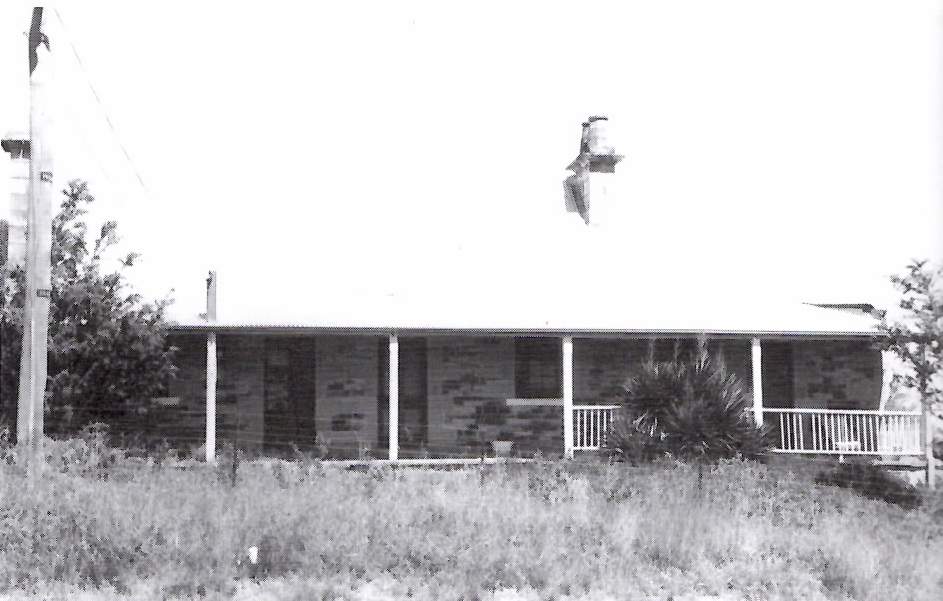 |
| House which was the Plough Inn |
Michael died on 26 September 1872, aged 62.
 |
| Ilford Cemetery, general view |
Children of Michael and Maria née Ring
Michael and Maria's six sons all married, mostly to young women from the Ilford area.
 |
| John Fairfield and Catherine (née Byrne) |
- John Fairfield (2nd great grandfather), born 1835 in Windsor, died 10 June 1869 at Round Swamp, married Catherine Byrne (2nd great grandmother) - see next chapter, born July 1833 in Carlow, Ireland, died 8 April 1914 at 'Tara', Ilford, aged 83. John and Catherine remained at Round Swamp for the first few years. In 1862, he bought two blocks totalling just over 40 acres not far from his father's farm on Tara Creek, and named the property "The Willow", John died of a "low fever" at Tara Creek in1869 aged 34, leaving Catherine with seven young children. With the help of her sons, Catherine kept the farm going. The eldest, Johnny, was 13 when his father died. Johnny lived to 91 years of age, and never married. he remained on 'The Willow' for most of his life, as did his brother Thomas "Dadder"(great grandfather), who married Fanny Weatherly (great grandmother) in 1893. They had 14 children. The property was enlarged by further purchases. Additional sources of income for the large family included the mail run between Ilford and Sofala.
- Laurence Ring, born 1835 at Mulgoa, died 28 March 1908 at Lithgow, married Esther Piesley in 1861, and following her death, Mary Finn in 1894
- Thomas, born 1836 at Mulgoa, died 1876 at Rylstone, married Frances Fitzpatrick in 1860. He died of typhoid and was buried at Ilford.
- Michael, born about 1840 at Mulgoa, died 1919 in Inverell. He married Eleanor (Ellen) Barnaby, daughter of an Inn-keeper at Round Swamp in 1866.
- Frederick, born 13 September 1842 at Penrith, died 1893, married Anne Murray, daughter of a local farmer. They later moved to Queensland.
- Robert, born 1845 at Emu Plains, died 9 April 1907 at Lithgow, married Harriet Giles, daughter of a local farmer and sister of Bridget Giles who married his cousin Daniel Bede Moore. Robert also died of typhoid and was buried at Bowenfels.
Children of John Fairfield and Catherine (née Byrne)
- John (Johnnie), born 12 December 1855 at St Marys, died 5 November 1946 'The Willow', Ilford. Never married.
- Michael, born 11 August 1857 at Round Swamp, died 1908 at Ilford
- Maria, born 1 May 1859 at Round Swamp, died 1939 at Parramatta, married Samuel Stackpoole
- Thomas "Dadder" (Great Grandfather), born 21 February 1861 at Round Swamp, died 2 November 1935 at Mudgee, married Fanny Weatherly, born 1872 Rylstone, died 6 July 1949 at Kandos. They had 14 children! One of them was Thessel Agnes - Tessa- (Grandmother) who married Ted Briggs.
 |
| Tom and Fanny Moore and the girls in the family |
- Robert Lawrence (Bob), born 16 December 1863 at Kean's Swamp, died 24 October 1949 at Rylstone, married Hannah Russell
- Daniel Joseph (Dan), born 12 January 1866 at Kean's Swamp, died 11 July 1945 at Ilford, married Catherine Minehan
- Mary Bridget, born 8 May 1868 at Rylstone
- Agnes, born 1869 at Kean's Swamp, died 1959 at Rylstone, married James Guthrie
 |
| Dan, Bob and Johnnie Moore |
Children of Thomas "Dadder" and Fanny née Weatherly
(i) Percy Hayden, born 1893 at Rylstone
 |
| Mel and Hayden Moore |
(ii) Norman Thomas, born 1895, died 1980
 |
| Norman Moore |
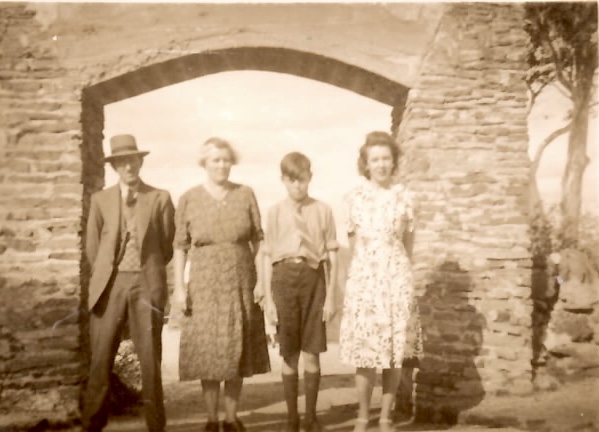 |
| Norman and Eileen with children Bernard and Yvonne |
(iii) Hilda Celestine, born 1897 at Rylstone, died 1944, married Thomas Partlett
(iv) Volney George, born 1899 Rylstone, married Kathleen Ritchie
(v) Thessel Agnes 'Tessa', born 27 February 1901 in Rylstone, died 8 August 1959, married Ted Briggs
 |
| Wedding of Tessa Moore and Ted Briggs at Moore house, Ilford |
 |
| Tess Moore and Ted Briggs wedding |
 |
| Tessa and Ted Briggs in the 1940s |
 |
| Tessa Briggs née Moore |
(vi) Daphne, born 1903 at Rylstone, died 1994 at Rylstone, married Douglas Neil Mills
 |
| Daphne Moore |
(vii) Sylvia Mary, born 1904 at Rylstone, died 2001, married Earl Reynolds
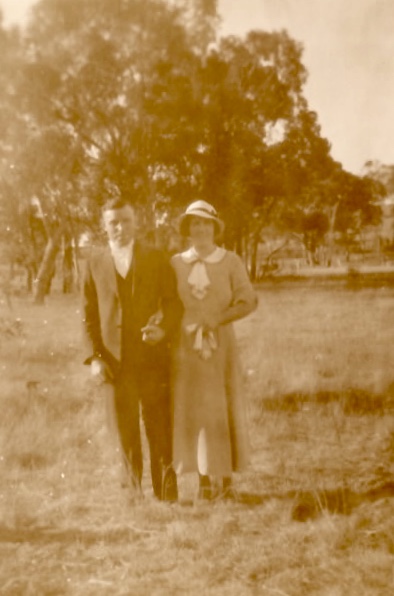 |
| Mary Moore and Earl Reynolds |
(viii) Doris Valerie, born 1906 at Rylstone
(ix) Colin Ernest, born 12 January 1909 at Rylstone, died 1997, married Marjorie
(x) Kathleen Beatrice, born 1910 at Rylstone
(xi) Irene, born 1912
(xii) Veronica Catherine, born 1914 at Rylstone, died 1994 at Mudgee
(xiii) Iris J, born about 1916 at Rylstone
(xiv) Mavis E, born about 1918 at Rylstone
 |
| Daphne, Doris and Mary Moore. Baby ? |
2. Daniel Moore 1812 Ireland - 15 July 1868 Ilford, NSW (4th great uncle)
Daniel was apprenticed to James Russell as a blacksmith at the 1828 census and continued in that trade all his life. It appears he spent several years in the Maitland district, then moved to Mudgee and later to Ilford.
Daniel's wife was Margaret Russell (née Moore), the widow of James Russell. They were married when he was 21 according to his death certificate. There is no record of the marriage in NSW.
According to his death certificate, Daniel had nine children, four of whom pre-deceased him. The five living when he died were:
- Daniel Bede, born 1835 - worked with his father as a blacksmith and also bought a number of larger blocks between the Sofala and Razorback Roads in Warrangunia Parish. He appears to be the only child who stayed in Ilford. He followed his father's trade and became a blacksmith, continuing to operate the smithy for some time after his father's death. In 1864 he married Bridget Giles, whose father was a police officer and later a publican at Sofala. Daniel had already bought land between Ilford and Sofala which, with additional purchases over time, became the property known as "Taraena" still owned by his descendants. He died in 1920 and was buried in Ilford.
- Mary, born about 1837
- Ellen, born about 1840 - married a horse-breaker named George Light at Mudgee in 1863.
- Catherine (known as Kate Maria), born about 1842 - married in 1861 to Thomas Readford, whose family lived near Ilford. Died in Orange in 1877, following the birth of her tenth child. Buried in Orange.
- Lawrence, born about 1845 - went north as a young man and spent the rest of his life in Queensland or northwestern NSW. He married Mary Anderson at St George in 1869. After working as a bullock driver around St George and as a stockman on various stations in the border district, he selected a block of land at Goodooga in NW NSW which he later transferred to Mary's step-father Beaumont Broadbent. Lawrence later selected another beside it. The two blocks together known as "Dhuroo" were the family home from 1875 until the early 1900s. Lawrence and Mary's nine surviving children grew up there and two others died as infants and are buried there. While at "Dhuroo" the challenges the family faced included a flood in 1890 which occurred while Mary was at home alone with the younger children and elderly parents. They were forced to take refuge on a nearby sandhill with no food except some flour and dripping until Lawrence was able to return. the waterhole near where the family lived is still known as Moore's Lagoon. Lawrence later lived at Augathella, Queensland where his son Larry had a small property. He died at his daughter's home near Thallon, Old in 1924 and is buried in the Thallon Cemetery.Two of Lawrence and Mary's sons served in France in World War 1. Tom was killed at Bullecourt in 1917 and is buried in an unmarked grave in a location described as "in the vicinity of Maricourt Wood." He is commemorated on the memorial at Villers-Bretonneux.Tom's brother Richard was seriously wounded but recovered.
Margaret is believed to have died in Sydney in 1845, not long after Lawrence was born.
Margaret had three children with James Russell
- James, born 2 June 1826 at Parramatta, died 31 August 1886 at Camperdown
- Elizabeth, born 19 June 1830 in Sydney, died 17 September 1903 at Oatlands
- John, born 2 March 1832 at Sydney, died 25 August 1907 in Toowoomba
After Margaret's death, Daniel established a relationship with a widow named Johanna Looney née Noonan. They were both arrested on forgery-related charges at Mudgee in 1849, having apparently come into town to be married. Johanna was acquitted, but Daniel, who had also been tried shortly before on a desperate charge of forgery, was sentenced to three years ion road gang on 22 September 1849. After serving a little over a year, he was freely and unconditionally pardoned on 18 October 1850.
Johanna was pregnant when she was arrested and gave birth to twin girls in Bathurst gaol. They were born in 1849 and named Margaret and Mary.
The relationship between Daniel and Johanna appears to have continued for a while after he was released from prison, but ended well before his death. Current members of both families were unaware of it until recently. A descendent of one of the twins contacted the Moore family a few years ago, having discovered the connection to Daniel.
When he entered prison Daniel was described as being 5 feet 61/2 inches tall, of stout build, with hazel eyes, a 'fresh' or 'pale' complexion, and 'brown' or 'dark' hair.
On 7 May 1860 he bought a 5 acre block of land on which he established a smithy. It was in the village of Ilford on the Mudgee Road near the intersection with the Sofala Road.
Daniel was the first of the Moore family to own land in the Ilford area. Within a year his brother Michael purchased his farm. The descendants of the two brothers live in the area today.
Daniel died suddenly on 15 July 1868 of a ruptured blood vessel and was buried at Round Swamp. His gravestone was erected by his sister-in-law Maria Moore (née Ring). The inscription reads:
Sacred to the memory of Daniel Moore who departed this life July 16th 1868, aged 52 years. May he Rest In Peace
All you that my grave do see
Prepare yourselves to follow me
Repent in time, Make no delay,
For I, in haste, was called away.
Erected by his affectionate sister-in-law, Maria Moore
3. John Moore 1813 Laois, Ireland - ? 1868 Mudgee (4th great uncle)
John was apprenticed as a baker in 1828.
He was arrested in Sydney and entered Darlinghurst Gaol on 12 October 1836 to await trial. He was discharged after trial on 1 November 1836. The gaol record describes him as 5 ft 11 inches tall, with a sallow complexion, black hair and hazel eyes, and his trade as blacksmith.
John Moore of Mulgoa (the same location as his mother and brother Michael married Catherine Dolan at St Nicholas Church, Penrith on 29 January 1855. Catherine was from The Sugar Loaf, which is not far east of Ilford. Witnesses at the marriage were John Byrne of Mount Vernan and Maria Moore (who would be Michael's wife) of Mulgoa.
A John Moore who had been in the colony for 43 years, that is, arrived in 1826, died at Lawson's Creek in 1868 and was buried at Mudgee. No information about his family is included in his death certificate and his age was stated to be 67, not 55.
There are numerous people born in NSW, some around Rylstone, in the years after 1855 with parents named as John and Catherine Moore.
4. Mary Moore 1827, Sydney NSW - (4th great aunt)
Nothing is known about Mary other than she was 11 months old at the 1828 Census.
For the information in this chapter I am indebted to Bob Starling and his publication Thames Immigration Ship Cork Ireland to Port Jackson, Sydney 1825-1826 Volume 2. Published October 2012, held in the collection of the Society of Australian Genealogists in Sydney.
Information also sourced from Over Cherry Tree Hill: 150 Years of Pioneer Settlement edited by Margaret Piddington, The Cherry Tree Hill Community Press, Ilford, 1989.


